# Lin D. et al., 2026: . Inhibition of Ferroptosis in Prostatitis Model by Low Intensity Extracorporeal Shock Wave Therapy through the Integrin-β1/NRF2 Axis.
Jens Rassweiler
Tuesday, 02 June 2026
297 Hits
[ 0 Comments ](https://www.storzmedical.com/en/disciplines/literature-database-blog/database-cpps-ipp-ed/lin-d-et-al-2026/?layout=listings#comments)
Lin D, Li K, Kuang W, Chen Z, Zhang M.
World J Mens Health. 2026 Apr;44(2):451-468. [doi: 10.5534/wjmh.250222](https://pubmed.ncbi.nlm.nih.gov/41714892/)
## Abstract
Purpose: Although low-intensity extracorporeal shock wave therapy (Li-ESWT) is used clinically for chronic prostatitis/chronic pelvic pain syndrome (CP/CPPS), its mechanisms remain inadequately understood. This study aimed to explore Li-ESWT-mediated mechanotransduction signaling and its association with ferroptosis in CP/CPPS models.
Materials and methods: Experimental autoimmune prostatitis (EAP) was induced by intradermal prostate antigen immunization. Rats received Li-ESWT, with additional groups treated with the ferroptosis inducer RAS-selective lethal 3 (RSL3) or iron chelator deferoxamine (DFO). The rats were analyzed histologically and biochemically to assess immune responses, fibrosis, oxidative stress, ferroptosis markers, and related signaling. In vitro, Li-ESWT was applied to lipopolysaccharide (LPS)-stimulated RWPE-1 cells. The Integrin-β1-NRF2-xCT/GPX4 axis was modulated via siRNA or overexpression plasmid, with Ferrostatin-1 used as a reference control. The changes in NRF2-xCT/GPX4 expression, ferrous iron, and lipid peroxidation were evaluated to clarify the mechanisms by which Li-ESWT regulates ferroptosis.
Results: EAP rats recapitulated key pathological features of CP/CPPS, which were alleviated by Li-ESWT. Specifically, Li-ESWT reduced the inflammatory response by inhibiting CD3⁺ T cells and CD68⁺ macrophages infiltration, suppressed fibrosis by preventing epithelial-mesenchymal transition and smooth muscle hyperplasia, and attenuated hyperalgesia by inhibiting mast cell degranulation. RSL3 exacerbated these pathological changes, whereas DFO attenuated them. Li-ESWT also suppressed oxidative stress and ferroptosis, as indicated by reduced reactive oxygen species and ferrous iron accumulation, lipid peroxidation, and ferroptosis-driving factors (ACSL4, LPCAT3, ALOX15, COX-2) levels. Li-ESWT also upregulated the Integrin-β1 and NRF2-xCT/GPX4 expression. In vitro, Integrin-β1 knockdown reduced NRF2, xCT, and GPX4 expression, abolishing the protective effects of Li-ESWT against LPS-induced ferroptosis, as evidenced by increased lipid peroxidation and ferrous iron accumulation. Similarly, NRF2 knockdown negated the anti-ferroptotic effect of Li-ESWT, whereas ectopic overexpression of xCT/GPX4 restored ferroptosis suppression.
Conclusions: Li-ESWT ameliorates inflammation, fibrosis, hyperalgesia in the CP/CPPS model, likely through ferroptosis mitigation via activating the Integrin-β1/NRF2 pathway.
## Comment Jens Rassweiler
The authors want to clarify the following question: Does Li-ESWT alleviate chronic prostatitis/CPPS by inhibiting ferroptosis, and if so, through which mechanotransduction pathway? For this issue, the authors specifically tested whether the pathway involves:
Li-ESWT → Integrin-β1 → NRF2 → xCT/GPX4 → ferroptosis inhibition
**Experimental Design**
The authors used
*1. An animal model: Male Wistar rats were divided into several groups, including:*
- Normal control
- Normal control + Li-ESWT
- EAP model (experimental autoimmune prostatitis model)
- EAP + Li-ESWT
- EAP + DFO (deferoxamine, an iron chelator and ferroptosis inhibitor)
- Normal control + RSL3 (ferroptosis inducer that inhibits GPX4)
- EAP + RSL3
- EAP + RSL3 + Li-ESWT
*2. A cell model: Human prostate epithelial RWPE-1 cells were treated with:*
- LPS to induce inflammatory stress
- Li-ESWT
- Fer-1 as a ferroptosis inhibitor
- siRNA knockdown of Integrin-β1 or NRF2
- xCT/GPX4 overexpression plasmids
**Results**
*1. Li-ESWT reduced prostatic inflammation*
The EAP model showed strong inflammatory infiltration in prostate tissue, including increased, such as
- CD3+ T cells
- CD68+ macrophages
- IL-6
- CCL2
- CCL3
RSL3 worsened inflammation, while DFO reduced it. Li-ESWT significantly decreased inflammatory lesions and immune cell infiltration. This supports the idea that ferroptosis contributes to chronic prostatic inflammation and that Li-ESWT has anti-inflammatory effects partly by suppressing ferroptosis.
*2. Li-ESWT reduced fibrosis*
EAP rats showed increased stromal collagen deposition and fibrosis. This was associated with epithelial-mesenchymal transition, shown by:
- Decreased E-cadherin
- Increased N-cadherin
- Increased α-SMA-positive smooth muscle thickening
Li-ESWT reversed these changes and reduced collagen accumulation. DFO had similar anti-fibrotic effects, while RSL3 aggravated fibrosis. This suggests that ferroptosis may contribute to prostate fibrosis in CP/CPPS-like disease.
*3. Li-ESWT alleviated pelvic pain and mast cell activation*
EAP rats had increased pelvic mechanical hypersensitivity, measured using von Frey filaments. RSL3 worsened pain responses. Li-ESWT reduced hyperalgesia and also inhibited mast cell activation, shown by reduced:
- Total mast cell number
- Degranulated mast cells
- TPSB2-positive cells
Because mast cells can release tryptase and histamine, which contribute to pain sensitization, this finding links Li-ESWT to reduced neuroimmune pain signaling.
*4. Li-ESWT restored antioxidant capacity*
EAP prostates showed increased oxidative damage, including:
- Increased ROS
- Increased MDA
- Reduced GSH
- Reduced SOD activity
Li-ESWT reduced ROS and MDA while increasing GSH and SOD activity. This indicates that Li-ESWT strengthens antioxidant defense in inflamed prostate tissue.
*5. Li-ESWT inhibited ferroptosis*
Ferroptosis was demonstrated by increased:
- Ferrous iron
- Lipid peroxidation
- ACSL4
- LPCAT3
- ALOX15
- PTGS2/COX-2
Li-ESWT reduced iron accumulation and lipid peroxidation markers. It also lowered PTGS2/COX-2 expression, supporting an anti-ferroptotic effect. The ferroptosis inhibitor DFO produced similar protective effects, while RSL3 worsened disease features.
**Proposed Mechanism**
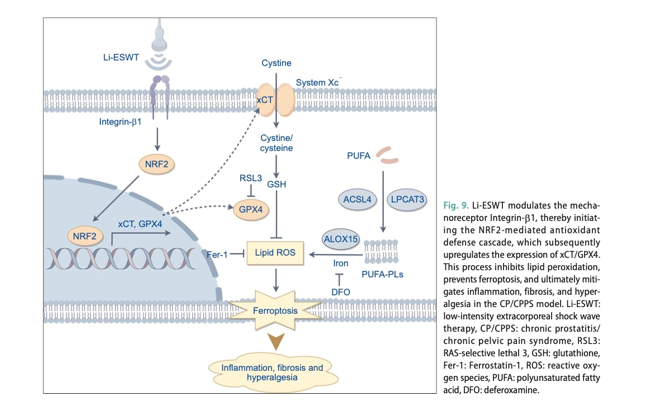
The central mechanism proposed is: Li-ESWT activates Integrin-β1, which restores NRF2 signaling. NRF2 then upregulates xCT and GPX4, improving antioxidant defense and suppressing ferroptosis. More simply (Fig. 9):
- Li-ESWT delivers mechanical stimulation to prostate tissue.
- This mechanical signal is sensed by Integrin-β1.
- Integrin-β1 activation increases NRF2, a master antioxidant transcription factor.
- NRF2 upregulates xCT and GPX4.
- xCT supports glutathione synthesis.
- GPX4 detoxifies lipid peroxides.
- Lipid peroxidation and iron-driven ferroptosis are reduced.
- Inflammation, fibrosis, mast cell activation, and pain are alleviated.
Cell Experiment Evidence
In RWPE-1 cells, LPS caused inflammatory stress and reduced:
- NRF2
- xCT
- GPX4
Li-ESWT restored these proteins and reduced lipid ROS and ferrous iron accumulation. However, when Integrin-β1 was knocked down, Li-ESWT could no longer restore NRF2, xCT, or GPX4 effectively. This suggests that Integrin-β1 is required for Li-ESWT’s anti-ferroptotic effect. When NRF2 was knocked down, Li-ESWT also lost much of its ability to increase xCT and GPX4. But overexpressing xCT and GPX4 rescued the anti-ferroptotic effect. This supports the pathway (Fig. 9):
Integrin-β1 → NRF2 → xCT/GPX4
**Conclusion**
The study concludes that Li-ESWT alleviates chronic prostatitis-like pathology by inhibiting ferroptosis. It does this through a *mechanotransduction pathway* involving Integrin-β1-mediated activation of NRF2, which then upregulates the anti-ferroptotic defense system xCT/GPX4.
As a result, Li-ESWT reduces:
- Iron overload
- Lipid peroxidation
- Oxidative stress
- Inflammation
- Fibrosis
- Mast cell activation
- Pelvic pain
**Discussion**
This study is important because it provides a possible molecular explanation for why Li-ESWT improves CP/CPPS symptoms. Clinically, Li-ESWT is already being explored as a non-invasive treatment for CP/CPPS, but its mechanism has not been fully understood. This article suggests that its benefit may come from blocking the inflammation-ferroptosis cycle in prostate tissue. The study also positions ferroptosis as a potential therapeutic target in CP/CPPS.
**Limitations**
The authors acknowledge several limitations:
- The precise signaling link between Integrin-β1 and NRF2 remains unclear.
- The detailed transcriptional regulation of xCT and GPX4 by NRF2 was not fully mapped.
- Findings are based on animal and cell models, not human CP/CPPS samples.
- More clinical evidence is needed to confirm whether Li-ESWT modulates ferroptosis markers in patients.
**One-Sentence Takeaway**
Li-ESWT may treat CP/CPPS by activating Integrin-β1-dependent NRF2 signaling, restoring xCT/GPX4 antioxidant defenses, suppressing ferroptosis, and thereby reducing prostate inflammation, fibrosis, and pain.
Jens Rassweiler
0
#### Comments
No comments made yet. Be the first to submit a comment
Tuesday, 28 July 2026
I have read and agreed to the [Privacy Policy](https://www.storzmedical.com/javascript:void(0);)


