# Yu WR. et al., 2026: Therapeutic efficacy of multimodal therapy for patients with interstitial cystitis/bladder pain syndrome refractory to previous bladder monotherapy.
Jens Rassweiler
Wednesday, 24 June 2026
112 Hits
[ 0 Comments ](https://www.storzmedical.com/en/disciplines/literature-database-blog/database-cpps-ipp-ed/yu-wr-et-al-2026/?layout=listings#comments)
Yu WR, Jhang JF, Jiang YH, Kuo HC.
Int Urol Nephrol. 2026 Jan 2. [doi: 10.1007/s11255-025-04981-6](https://pubmed.ncbi.nlm.nih.gov/41483139/)
## Abstract
Purpose: Interstitial cystitis/painful bladder syndrome (IC/BPS) is a debilitating chronic condition, and current treatments rarely achieve complete symptom relief. This study evaluated the efficacy of intensive multimodal therapy (MMT) for IC/BPS based on individualized clinical assessments within a 3-month period.
Methods: Thirty-one patients with IC/BPS who had failed prior monotherapy were enrolled. Following comprehensive evaluation, patients received tailored MMT, which could include anti-inflammatory medications, intravesical hyaluronic acid instillation, intravesical or urethral botulinum toxin A (BoNT-A) injection, pelvic floor BoNT-A injection, platelet-rich plasma injection, low-energy shockwave therapy, pelvic floor massage for pelvic floor muscle pain (PFMP), and/or medications for anxiety, depression, voiding dysfunction, or bladder hypersensitivity. The primary outcome was assessed at 3 months using the global response assessment (GRA), with a successful response defined as a GRA score of 2 or 3. Patients were followed for up to 1 year.
Results: Of the 31 patients (28 women, 3 men), 18 (58.1%) reported a successful outcome at 3 months. Successful and unsuccessful subgroups showed significant improvements in symptom scores and glomerulation grade after cystoscopic hydrodistention. However, reductions in pain VAS and daytime frequency were observed only in the successful subgroup. Similarly, PFMP parameters improved significantly in the successful subgroup, but not in the failed subgroup. Sustained therapeutic effects were observed in 21 patients (67.7%) at 9 months and in 23 patients (74.2%) at 1 year after MMT.
Conclusion: Multimodal bladder therapy, incorporating bladder- and extra-bladder-targeted approaches, yields satisfactory outcomes in patients with IC/BPS unresponsive to prior monotherapy.
## Comment Jens Rassweiler
**Background and Objectives**
Interstitial cystitis/bladder pain syndrome (IC/BPS) is a chronic condition characterized by bladder pain, urinary frequency, urgency, and reduced quality of life. Many patients do not respond adequately to single bladder-directed therapies such as intravesical hyaluronic acid, botulinum toxin A, platelet-rich plasma, or low-energy shockwave therapy.
Because IC/BPS may involve multiple mechanisms—including bladder inflammation, urothelial dysfunction, pelvic floor muscle pain, psychological stress, and central sensitization—the authors evaluated whether an individualized **multimodal therapy (MMT)** approach could improve outcomes in patients who had failed previous monotherapy.
**Methods**
**Study Design**
This was a prospective preliminary clinical study involving 31 patients with IC/BPS.
Participants (28 women, 3 men). The majority suffered from non-Hunner interstitial cystitis.
All patients had previously failed at least 3 months of bladder monotherapy, including: Intravesical botulinum toxin A, platelet-rich plasma injection, low-energy shockwave therapy, and hyaluronic acid instillation
**Baseline Assessments**
Patients underwent extensive evaluation, including:
- Interstitial Cystitis Symptom Index
- Interstitial Cystitis Problem Index
- O’Leary–Sant Symptom Score
- Bladder pain visual analog scale
- 3-day voiding diary
- Functional bladder capacity
- Videourodynamic study
- Cystoscopic hydrodistention
- Glomerulation grading
- Pelvic floor muscle pain assessment
- Psychological assessments for stress, anxiety, and depression
**Treatment Approach**
Treatment was individualized according to each patient’s clinical findings. Multimodal therapy could include:
- Anti-inflammatory medications
- Intravesical hyaluronic acid
- Intravesical botulinum toxin A
- Intravesical platelet-rich plasma
- Urethral sphincter botulinum toxin A
- Pelvic floor muscle botulinum toxin A
- Low-energy shockwave therapy
- Pelvic floor massage
- Medications for bladder hypersensitivity or voiding dysfunction
- Psychological or psychiatric medications when indicated
The main outcome was treatment response at 3 months using the Global Response Assessment, where a score of 2 or 3 was considered successful.
**Results**
**Overall Treatment Success**
At 3 months:
- **18 of 31 patients**, or **1%**, achieved successful treatment outcomes.
- 10 patients had GRA = 2
- 8 patients had GRA = 3
At later follow-up:
- 6 months: **6%**
- 9 months: **7%**
- 12 months: **1%**
This suggests that the benefit of multimodal therapy may increase over time.
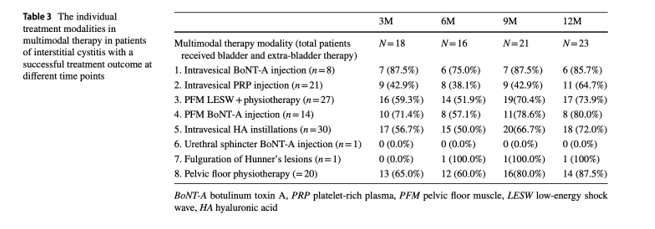
**Treatment-Specific Findings**
The highest success rates were observed in patients receiving:
*Intravesical botulinum toxin A*
- Success: **7/8 patients**
- Success rate: **5%**
*Pelvic floor muscle botulinum toxin A*
- Success: **10/14 patients**
- Success rate: **4%**
*Pelvic floor massage*
- Success: **13/20 patients**
- Success rate: **0%**
These findings suggest that both bladder-directed therapy and pelvic floor-directed therapy may be important in refractory IC/BPS.
In this study, Li-ESWT combined with pelvic floor physiotherapy achieved a success rate comparable to pelvic floor Botox injection (73.9%), with the advantage of being non-invasive. This suggests that Li-ESWT plus physiotherapy may be a reasonable earlier treatment option before proceeding to invasive pelvic floor Botox, although randomized comparative studies are needed to confirm equivalence or superiority.
**Discussion**
The study supports the concept that IC/BPS is not always purely bladder-centred. In many patients, symptoms may be influenced by:
- Pelvic floor dysfunction
- Chronic inflammation
- Urothelial barrier dysfunction
- Psychological stress
- Cross-organ pelvic pain mechanisms
- Central nervous system sensitization
Therefore, bladder monotherapy may be inadequate for refractory patients. A tailored multimodal strategy may provide better and more durable symptom control.
*Strengths of the Study*
This included the following
*-* **Prospective design**: Patients were followed systematically after treatment.
*-* **Comprehensive evaluation**: The study assessed bladder, pelvic floor, voiding, cystoscopic, and psychological factors.
*-* **Individualized treatment strategy**: Therapy was selected based on each patient’s clinical phenotype.
*-* **Longer follow-up**: Patients were followed up to 1 year, showing sustained or increasing treatment response.
*-* **Focus on refractory patients**:The study addressed a clinically difficult population that had already failed monotherapy.
*Limitations*
This includes:
\- **the small sample size**: Only 31 patients were included, limiting statistical power.
\- **heterogeneous treatments without controls:** Patients received different combinations of therapies, making it difficult to isolate which component was most effective.
\- **hydrodistention may have therapeutic effects**: Cystoscopic hydrodistention was performed during assessment and may itself have contributed to symptom improvement.
**Clinical Significance**
This study suggests that patients with IC/BPS who fail bladder monotherapy may benefit from a broader clinical approach that addresses both bladder and extra-bladder contributors.
In particular, clinicians should assess for:
- Pelvic floor muscle pain
- Psychological stress
- Bladder hypersensitivity
- Voiding dysfunction
- Hunner lesions
- Urothelial dysfunction
Patients with pelvic floor tenderness may especially benefit from pelvic floor-directed treatments such as pelvic floor massage, physiotherapy, Li-ESWT or botulinum toxin A injection.
**Conclusion**
The study concludes that individualized multimodal therapy can provide satisfactory and durable improvement in patients with refractory IC/BPS. The findings support a phenotype-directed approach rather than relying on bladder monotherapy alone.
The most notable clinical message is that refractory IC/BPS often requires treatment of both bladder pathology and extra-bladder factors, especially pelvic floor muscle pain.
Jens Rassweiler
0
#### Comments
No comments made yet. Be the first to submit a comment
Thursday, 30 July 2026
I have read and agreed to the [Privacy Policy](https://www.storzmedical.com/javascript:void(0);)


