
Extracorporeal Magnetotransduction Therapy (EMTT) in orthopaedics: Applications for musculoskeletal conditions

Osteoarthritis, back pain or tendinopathy: Musculoskeletal conditions can significantly impair quality of life. Extracorporeal magnetic transduction therapy (EMTT) offers a state-of-the-art, non-invasive treatment option that is used for a range of musculoskeletal complaints.
Find out here which orthopaedic indications can be treated using EMTT, which biological processes are involved, and why the therapy is becoming increasingly important, particularly for chronic musculoskeletal conditions.
Applications of EMTT for musculoskeletal conditions
Musculoskeletal conditions cover a wide range of health problems affecting the musculoskeletal system, from muscles, bones and joints to tendons, ligaments, cartilage and intervertebral discs. They are among the most common causes of chronic pain around the world.
EMTT was developed specifically to treat these conditions and is being used as a non-invasive, well-tolerated treatment option. Typical applications of EMTT include:
- Degenerative joint diseases: Wear and tear conditions such as osteoarthritis (knees, hips, hands, shoulders, elbows), herniated discs, spondyloarthritis
- Pain treatment: Chronic and acute pain, e.g. back pain, lower back pain, muscular tension, radiculopathy, heel pain
- Sports injuries: (Chronic) inflammation of tendons and joints, tendon overuse syndromes, osteitis pubis
EMTT as part of combined treatment approaches
In orthopaedic practice, EMTT is frequently used as a complementary treatment option within combined treatment plans. For example, it can be combined with physiotherapy, extracorporeal shock wave therapy (ESWT) or movement therapy to support conservative treatment approaches for chronic conditions.
What is the mechanism of action of EMTT and its biological effects?
EMTT involves treating painful areas of the body with high-energy magnetic pulses. The field strengths used here are within the therapeutically relevant range (≥ 10 mT). Thanks to its unique combination of high oscillation frequency, magnetic field strength and penetration depth (up to 18 cm), EMTT differs significantly from conventional magnetic field therapies or pulsed electromagnetic fields (PEMF).
The way the EMTT works can be explained simply as follows: During treatment, an electric current flows in a circular pattern through the coil of the EMTT handpiece, generating a magnetic field around the coil. This magnetic field, in turn, induces an electric current in the body’s tissues.
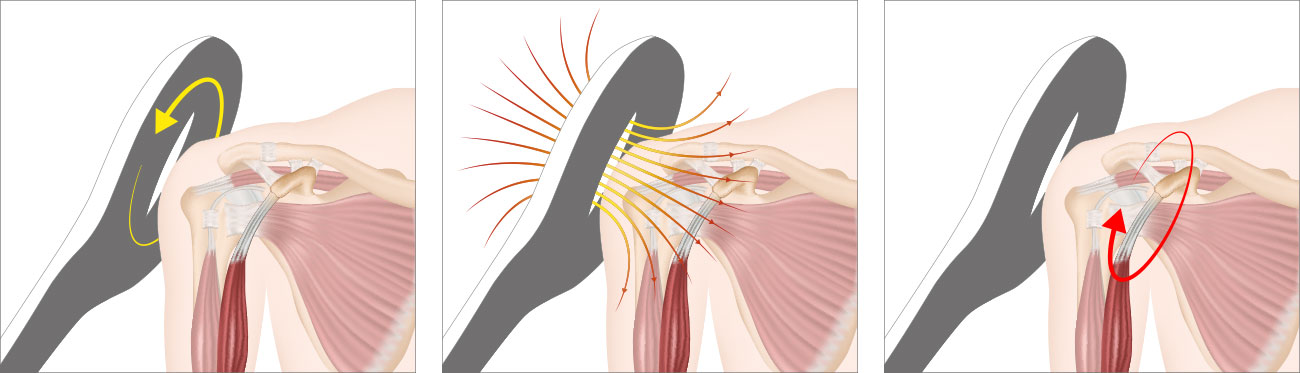
Electromagnetic stimulation
Good to know: The therapeutic effect is not due to the magnetic field itself, but to the electrical stimuli it induces in the tissue. The electrical energy delivered to the tissue can trigger two key phenomena: piezoelectricity and electroporation. These phenomena are associated with anti-inflammatory and cell-stimulating effects.
Piezoelectricity: Collagen-rich structures, such as bones, muscles, tendons and ligaments, can generate electrical voltages when subjected to mechanical stress. These influence cell membranes and ion channels and are linked to processes that can affect inflammation, muscle tension and blood circulation. Overall, these processes are thought to be linked to potential pain relief.
Electroporation: During electroporation, the permeability of the cell membrane changes temporarily. This can facilitate the exchange of certain molecules. This effect has been linked to biological processes that may support anti-inflammatory mechanisms.
You can find out more about the biological principles and mechanism of action of EMTT here.
Therapeutic classification of EMTT
EMTT is a non-invasive addition to the range of conservative treatments for musculoskeletal conditions. Thanks to its physical properties, it can also reach deeper tissue structures and be incorporated into combined treatment approaches for chronic conditions.


