
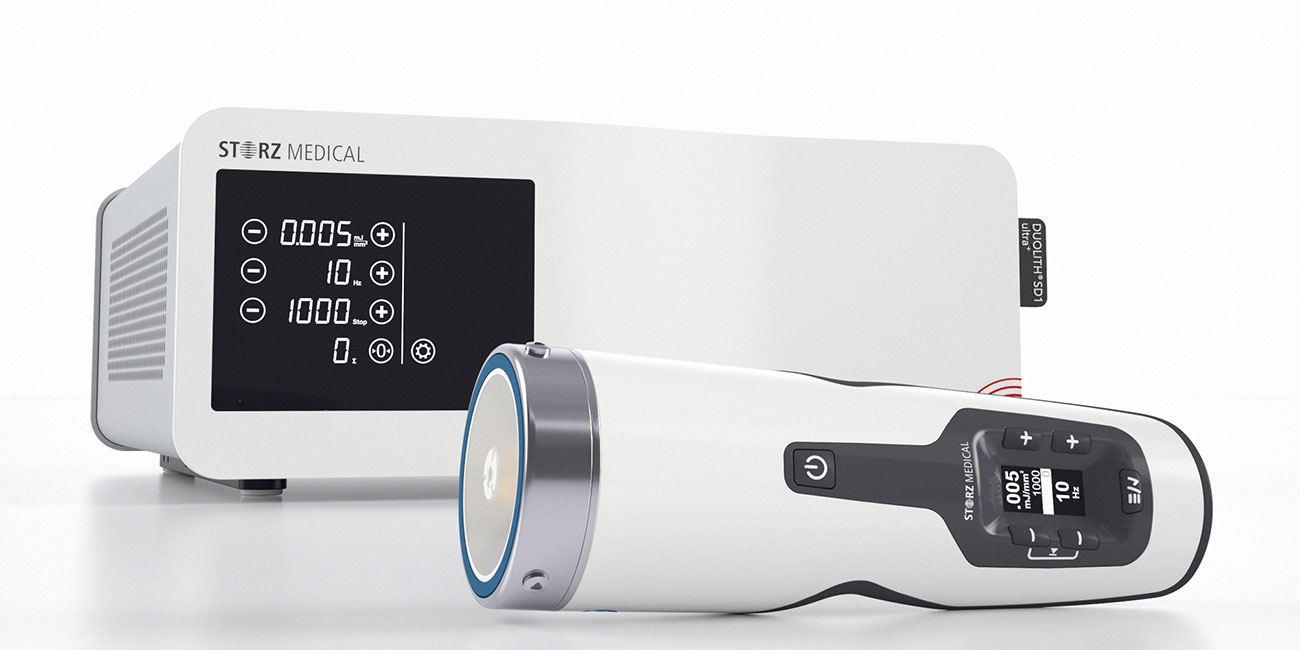
Extracorporeal shock wave therapy (ESWT) is used as a complementary, non-invasive treatment option in orthopaedics, sports medicine and other fields. Anyone wishing to expand their range of services to include focused shock wave therapy is faced with the question of how to integrate the technology seamlessly into their treatment workflow.
The new DUOLITH® SD1 T-TOP ultra+ has been developed for users in practices and clinics who wish to expand their range of treatments with a state-of-the-art therapy system that is economically sound and tailored to the demands of day-to-day practice. With an energy range of 0.005 to 0.55 mJ/mm2 and a simple operating concept, the system is designed to ensure that the focus remains where it should be: on the patient.
What is focused shock wave therapy?
A focused shock wave is an acoustic wave that transmits a large amount of energy in a very short space of time and discharges it at a distant point. The ability to concentrate energy and deliver it to a specific target area within the tissue has been utilised in focused shock wave therapy. Pulses ranging from low to high energy are used, depending on the indication and the target structure. The underlying mechanism of action is based on the principle of mechanotransduction; which means that the shock wave triggers the conversion of mechanical stimuli into biochemical signals within the cell. In this context, the literature describes, amongst other things, effects on pain perception, microcirculation and metabolism.1,2,3 Further information on the generation of shock waves and the mechanism of action of mechanotransduction can be found in the section »Shock waves: Physics and technology«.
Focused vs radial: When is each technology used?
In orthopaedic practice, both radial and focused shock waves are used for musculoskeletal conditions and they differ in their physical properties. Radial shock waves or pressure waves reach their peak energy at the surface, in the vicinity of the treatment site,3 while focused shock waves concentrate their energy in a focal zone within the tissue and can reach deeper structures.2 The choice of technology depends on the location and depth of the target structure, the size of the area to be treated and individual clinical requirements. The two technologies are not in competition with one another, but can complement each other in practice.3,4
The DUOLITH® SD1 T-TOP ultra+ at a glance
The new system is based on the tried-and-tested DUOLITH® technology and offers a wider energy spectrum and a higher shock wave frequency. With its intuitive operating concept, it supports efficient and flexible use in day-to-day practice.
Speed. Efficiency in day-to-day clinical practice.
The new DUOLITH® has been developed for frequencies of up to 10 Hz and enables rapid pulse delivery for a time-efficient treatment procedure.
The workflow is streamlined during treatment thanks to the intuitive operation via the integrated touch screen and the ease of adjusting all relevant parameters on the handpiece.
»Nano-Energy«: Energy delivery in precise increments from 0.005 mJ/mm2
With »Nano-Energy« – an energy range of 0.005 to 0.01 mJ/mm2 – the system enables finely graduated delivery at low energy levels. This provides additional flexibility when adjusting the parameters to suit the condition and the patient’s individual pain tolerance.
A wide range of applications for musculoskeletal disorders.
Focused shock wave therapy is used to treat a range of musculoskeletal conditions. These include, but are not limited to, rotator cuff tendinopathies with or without calcification (calcific tendinitis), lateral and medial epicondylitis (tennis elbow and golfer’s elbow), patellar and Achilles tendinitis, plantar fasciitis, as well as pseudarthrosis or delayed fracture healing.
With a focus zone of 0–65 mm, which may vary depending on the standoff distance used, and a penetration depth of up to 125 mm, the focused SEPIA® handpiece can be used to provide targeted treatment of different tissue structures.
The optionally available C-ACTOR® handpiece expands the range of applications to include superficial treatments in orthopaedics, urology and dermatology, particularly in cases of impaired wound healing.
SEPIA® and C-ACTOR®: Technical specifications at a glance
SEPIA® handpiece
Penetration depth up to 125 mm
Energy flux density 0.005–0.55 mJ/mm2
»Nano-Energy« range 0.005–0.01 mJ/mm2
Frequency up to 10 Hz
Focal zone 0–65 mm (adjustable depending on the standoff distance)
C-ACTOR® handpiece (optional)
Penetration depth up to 65 mm
Energy flux density 0.015–1.24 mJ/mm2
-
Frequency up to 10 Hz
Focal zone 0–40 mm (adjustable depending on the standoff distance)
Have you been working with radial shock waves so far? Expand your portfolio with focused shock wave therapy
Practices that already use radial shock wave therapy can specifically expand their range of treatments by incorporating focused shock wave therapy. The new DUOLITH® complements the product range in situations where energy needs to be applied precisely to a specific area. Both technologies may be used in combination depending on the indication, target structure and clinical assessment.
Would you like to replace an existing appliance?
For users who are already employing focused shock wave therapy and wish to modernise their equipment, the new DUOLITH® offers a well-thought-out design that is engineered to require minimal maintenance. The system combines technical innovations with the requirements of efficient day-to-day treatment.
Focused shock wave therapy for your practice
Request a personalised quote now via our contact form and discover the possibilities offered by the new DUOLITH® SD1 T-TOP ultra+ for your day-to-day practice.

Frequently asked questions about extracorporeal shock wave therapy (ESWT)
Focused vs radial: What is the physical difference?
Focused and radial shock waves differ in terms of how they are generated and how their energy is distributed within the tissue.3 Radial shock waves, or pressure waves reach their peak energy at the surface, in the vicinity of the application site; the energy decreases as the penetration depth increases. With focused shock waves, on the other hand, the energy is concentrated in a specific focal zone. The penetration depth may vary depending on the application and system; with the new DUOLITH® system and the focused SEPIA® handpiece, it is approximately 125 mm. The penetration depth of radial shock waves can be up to 50 mm, depending on the system used.
Can focused shock wave therapy complement radial shock wave therapy?
The use of focused and radial shock wave systems depends on the indication, the target structure and clinical assessment. Both methods may complement one another within the range of treatments available.3,4
What does ‘energy flux density’ mean?
Energy flux density is a key physical parameter in focused shock wave therapy. It describes the energy per unit area within the focal zone and is expressed in millijoules per square millimetre (mJ/mm2). The new DUOLITH® SD1 T-TOP ultra+, when used with the SEPIA® handpiece, offers an energy range of 0.005–0.55 mJ/mm2. The C-ACTOR® handpiece, with an energy range of 0.015–1.24 mJ/mm2, is available as an optional accessory.
What is »Nano-Energy«?
»Nano-Energy« is the name given by STORZ MEDICAL to the very low energy range of 0.005–0.01 mJ/mm2 in its new DUOLITH® SD1 T-TOP ultra+. This enables the delivery of energy in very small increments.
What happens during a shock wave treatment?
Shock wave treatment is carried out on an outpatient basis at the therapist’s practice. The duration of treatment depends on the indication, parameter settings and clinical course.
- Medical history interview, diagnosis and assessment of indications and contraindications
- Localisation of the target structure, clinically and/or by imaging
- Application of gel to transmit the shock waves to the treatment area
- Selection of treatment parameters according to the indication, target structure and clinical assessment
- Application of shock waves and, where necessary, adjustment of the parameters in keeping with intended use according to biofeedback
- Documentation of the treatment and determination of the next steps based on the clinical assessment
What scientific evidence is there regarding extracorporeal shock wave therapy (ESWT)?
ESWT has been the subject of numerous scientific publications on various indications and areas of application. The available evidence on this is wide-ranging: studies differ in terms of the types of equipment used, energy flux densities, pulse counts and treatment protocols.
An overview of the scientific literature on ESWT can be found in the STORZ MEDICAL literature database, where you can search specifically for publications on various indications and areas of application.
Would you like to know whether the DUOLITH® SD1 T-TOP ultra+ is right for your practice? Request your personalised quote now using the contact form.
References
1. Saxena, A., et al. (2025). Extracorporeal shock wave therapy (ESWT) and radial pressure waves (RPW) may improve post-operative recovery following insertional Achilles tendon surgeries: a case-control pilot study. J Orthop Surg Res. 20 (751). doi:10.1186/s13018-025-06165-5
2. Nedelka, T., et al. (2025). Efficacy of high-energy, focused ESWT in treatment of lumbar facet joint pain: a randomized sham-controlled trial. International Journal of Surgery 111 (7): 4177–4186. doi: 10.1097/JS.0000000000002538
3. Moya, D., et al. (2018) The Role of Extracorporeal Shockwave Treatment in Musculoskeletal Disorders. Journal of Bone and Joint Surgery 100(3): 251–263. doi10.2106/JBJS.17.00661
4. Rhim H.C., et al. (2025). Recommendations for use of extracorporeal shockwave therapy in sports medicine: an international modified Delphi study. British Journal of Sports Medicine, 59(18), 1287-1301. doi.10.1136/bjsports-2024-109082