

Xu HW. et al., 2025: Efficacy of external physical vibration lithecbole combined with tamsulosin in upper ureteric stones after ESWL: a prospective randomized clinical trial.
He-Wei Xu, Xiao Liang, Yu-Hao Wang, Ya-Xiong Xu, Hui-Qing Li, Yun-Peng Li
Sci Rep. 2025 Nov 3;15(1):38305. doi: 10.1038/s41598-025-22157-1
Abstract
This study aimed to evaluate the efficacy and safety of combining external physical vibration lithecbole (EPVL) with tamsulosin to enhance the clearance of upper ureteric stones (10-20 mm) after extracorporeal shock wave lithotripsy (ESWL). In a prospective, randomized clinical trial, patients with upper ureteric stones were allocated to a control group receiving ESWL followed by daily tamsulosin (0.4 mg) or a treatment group receiving both ESWL and EPVL in addition to tamsulosin. The primary endpoint, the stone-free rate (SFR), was assessed at 1, 2, and 4 weeks post-ESWL. Secondary endpoints included complication rates, with radiologic evaluations conducted at predetermined intervals to monitor stone clearance. In this randomized trial involving 211 participants, 106 received the intervention, while 105 served as controls. EPVL significantly enhanced stone fragment clearance. At week one, the SFR between the groups was similar (51.9% vs. 45.4%, P = 0.912). However, at weeks two and four, the treatment group demonstrated significantly higher SFR of 81.1% and 90.6%, respectively, compared to 64.8% and 75.2% in the control group (P = 0.020 and P = 0.011). No significant differences were observed in complication rates (P > 0.05). The treatment group underwent an average of 6.2 EPVL sessions, with a mean stone expulsion time of 20.3 ± 4.7 days. The combination of EPVL and tamsulosin following ESWL significantly increased the SFR while maintaining a favorable safety profile, suggesting that this integrated approach could offer a more effective treatment pathway for stone expulsion. Further studies in larger, multi-center cohorts are needed for validation.
Comment Hans-Göran Tiselius
This report is highly interesting because it highlights the use of physical lithecbole in combination with an alpha-receptor antagonist for improving fragment elimination after SWL of proximal ureteral stones.
Lithecbole (EPVL) is an oscillating external vibration device developed for physically improved fragment elimination. The study was designed to compare the effect of EVPL + tamsulosin and tamsulosin alone.
The enhanced fragment clearance with EPVL is impressive and the vibration device seems very useful, but this equipment is probably only available in China.
It is of note, however, that also with EVPL treatment there was
a relatively long expulsion time (20.3±4.7 days).
Below is the essential summary of the project.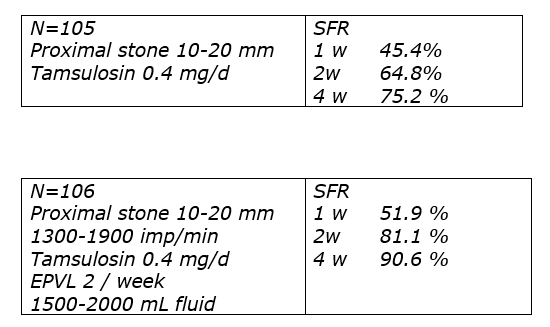
Hans Göran Tiselius


Comments