

Coffey S. et al., 2026: Lack of sustained improvements in erectile function following low-intensity extracorporeal shockwave therapy correlate with decreases in corporal brain-derived neurotropic factor: a pilot study and prospective clinical trial.
Coffey S, Nguyen V, Matthew AN, Kastelberg BS, Teves ME, Ghatas M, Klausner AP, Smith RP, Krzastek SC.
Sex Med. 2026 Jan 22;13(6):qfaf107. doi: 10.1093/sexmed/qfaf107
Abstract
Background: Low-intensity extracorporeal shockwave therapy (Li-ESWT) is thought to treat erectile dysfunction (ED) by stimulating neovascularization and nerve regeneration as demonstrated in animal models by histologically increased angiogenesis and neuronal-related growth factors, though corresponding human studies are limited.
Aim: We hypothesized that Li-ESWT results in appreciable increases in growth factors in human tissues, and in this proof-of-concept study we aimed to determine whether markers for neovascularization and nerve regeneration can be detected in the corporal blood of men following Li-ESWT treatment.
Methods: Patients were prospectively enrolled in a clinical trial of Li-ESWT for ED. Patients received 12 bi-weekly Li-ESWT treatments of 0.2 mJ/mm2 at 5 Hz, 1500 shocks delivered per treatment, with follow up at 1-2 weeks, 4-6 weeks, 3 months, and 6 months post-treatment. Cavernosal penile blood samples were obtained prior to treatment and at each visit post-treatment. The concentrations of endothelial nitric oxide synthase (eNOS), neuronal nitric oxide synthase (nNOS), vascular endothelial growth factor (VEGF), and brain-derived neurotropic factor (BDNF) in penile plasma samples were measured using enzyme-linked immunosorbent assay with specific commercial kits, following the protocols provided by the manufacturer.
Outcomes: eNOS, nNOS, VEGF, and BDNF were detectable and demonstrated changes in cavernosal plasma samples following Li-ESWT treatment.
Results: Twenty-five patients completed all five study visits. Mean patient age was 63. Mean baseline International Index of Erectile Function-Erectile Function score prior to treatment was 14.24 (±1.21). Corporal plasma samples were analyzed for eNOS, nNOS, VEGF, and BDNF using the enzyme-linked immunosorbent assay. Levels of eNOS, nNOS, and VEGF showed an upward trend following treatment but did not reach significance. BDNF levels were noted to decrease.
Clinical implication: Corporal blood aspirates may function as surrogates for histological studies to understand effects of Li-ESWT at the tissue level in humans.
Strengths and limitations: To our knowledge, this is first the molecular study in human tissues to attempt to quantify neurogenesis and neovascularization in penile tissue following Li-ESWT for ED. Although our sample size is small, we believe this represents a promising first step in understanding the effect of Li-ESWT at a tissue level in men.
Conclusion: The clinical significance of our findings is currently unknown, but markers of neovascularization and neurogenesis are detectable in corporal plasma and may change following Li-ESWT. ClinicalTrials.gov ID NCT04720755.
Comment Jens Rassweiler
Objectives
This pilot prospective clinical trial investigates whether low-intensity extracorporeal shockwave therapy (Li-ESWT) for erectile dysfunction produces detectable molecular changes in human penile corporal blood. The authors measured four biomarkers associated with angiogenesis and neuroregeneration: endothelial nitric oxide synthase, neuronal nitric oxide synthase, vascular endothelial growth factor, and brain-derived neurotrophic factor.
Methods
Twenty-five men with erectile dysfunction completed a 6-week Li-ESWT protocol and were followed for up to 6 months. Patients were treated with focused linear shockwaves using the Storz Duolith SD1 device. Patients received twice-weekly treatments of 0.2 mJ/mm2 over the right and left penile shaft (500 shocks per site), and bilateral crura (250 shocks per site), for a total of 3000 shocks per week, for 6 weeks (total of 18000 shocks).
Corporal blood samples were collected before treatment and at several post-treatment time points. The study found that eNOS, nNOS, and VEGF showed nonsignificant upward trends after treatment, while BDNF significantly decreased over time, especially by 6 months. The authors conclude that corporal blood aspirates may be useful as a minimally invasive surrogate for studying tissue-level molecular effects of Li-ESWT in humans.
Results
The most important finding is that molecular markers related to erectile tissue biology can be detected in corporal blood samples. This is valuable because direct penile tissue biopsy is usually impractical or unethical in living patients.
The biomarker results were:
- eNOS: increased modestly after treatment, but not significantly.
- nNOS: increased modestly after treatment, but not significantly.
- VEGF: showed a general upward trend, especially in some subgroups, but was not statistically significant.
- BDNF: decreased significantly over time, particularly at the 6-month follow-up.
The BDNF result is the most surprising because previous animal studies have generally suggested that Li-ESWT may increase neuro-regenerative markers, including BDNF.
Discussion
Clinical Significance
The clinical significance of the biomarker changes remains uncertain. The increases in eNOS, nNOS, and VEGF are biologically plausible because Li-ESWT is thought to improve erectile function through angiogenesis, endothelial repair, and neural regeneration. However, because these increases did not reach statistical significance, the findings should be interpreted cautiously.
The decrease in BDNF is more difficult to interpret. It could suggest that human tissue response differs from animal models, that BDNF rises early and then declines later, or that longer-term nitric oxide-related signaling downregulates BDNF secretion. The study does not prove that reduced BDNF is harmful or beneficial in this context.
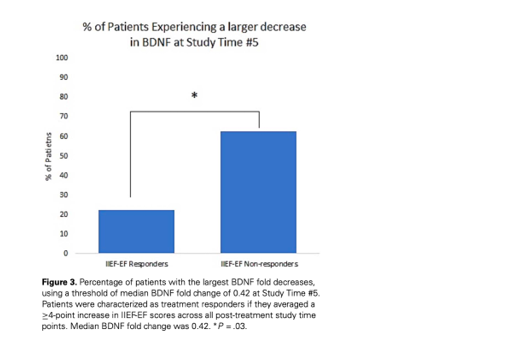
Interestingly, patients who responded clinically to Li-ESWT were more likely to have larger decreases in BDNF by 6 months, but the relationship between BDNF fold change and IIEF-EF score was weak overall.
Strengths of the Study
The following issues support the strenghts of the study.
- Novel human molecular data This appears to be among the first studies attempting to measure angiogenic and neurogenic biomarkers directly from corporal blood in men undergoing Li-ESWT.
- Prospective design Patients were followed over time with predefined study visits.
- Multiple follow-up time points Biomarkers were assessed immediately after treatment and up to 6 months later, allowing observation of longer-term trends.
- Standardized treatment protocol All patients received the same Li-ESWT protocol administered by the same trained urologist.
- Use of validated erectile function measures The study included IIEF-EF, EHS, Sexual Encounter Profile questions, and Doppler parameters..
Limitations
This includes:
- Small sample size Only 25 patients completed the study. This limits statistical power, especially for subgroup analyses by age or erectile dysfunction severity.
- No sham-control group Without a placebo or sham-treatment arm, it is difficult to separate true treatment effects from natural variation, placebo effect, or procedural effects.
- Underpowered for biomarker outcomes The study was powered to detect a clinical improvement in IIEF-EF score, not molecular biomarker changes. Therefore, nonsignificant biomarker trends may reflect insufficient power.
- Unclear clinical meaning of biomarker fold changes The study does not establish what magnitude of change in eNOS, nNOS, VEGF, or BDNF is clinically meaningful.
Overall Interpretation
This is an exploratory proof-of-concept study rather than a definitive efficacy trial. Its main contribution is not that it proves Li-ESWT improves erectile function through angiogenesis or neurogenesis, but that it demonstrates a feasible method for measuring relevant molecular markers in human corporal blood.
The observed upward trends in eNOS, nNOS, and VEGF are consistent with the proposed biological mechanism of Li-ESWT, but they are not statistically conclusive. The significant decrease in BDNF is unexpected and may indicate that the neurobiological response to Li-ESWT is more complex than previously suggested by animal models.
Conclusion
This study provides early evidence that corporal blood sampling can detect molecular markers associated with erectile tissue repair after Li-ESWT. The findings are promising from a research-methodology perspective, but they do not yet establish clear clinical biomarkers of treatment response.
Larger randomized sham-controlled trials are needed to determine whether changes in eNOS, nNOS, VEGF, or BDNF reliably correlate with erectile function improvement and whether these markers can help identify which patients are most likely to benefit from Li-ESWT.
Jens Rassweiler


Comments