

Sandoval-Salinas C. et al., 2026: Effectiveness of monthly maintenance low-intensity shockwave therapy added to a weekly protocol for erectile dysfunction: multicenter open-label randomized study.
Carolina Sandoval-Salinas, Juan M Martinez, Hector A Corredor, Jorge Barba, Francisco Patrón
J Sex Med. 2026 Mar 7;23(4):qdag076. doi: 10.1093/jsxmed/qdag076
Abstract
Background: Shockwave therapy is used as an adjunct to pharmacological treatment in erectile dysfunction; however, no standardized application protocol has yet been established.
Aim: To evaluate the effectiveness of adding 5 monthly maintenance shockwave therapy sessions to a 6-weekly-session protocol for the treatment of erectile dysfunction.
Methods: A total of 186 men with organic erectile dysfunction, not receiving pharmacological treatment, participated in a multicenter open-label randomized clinical trial. Participants were allocated to receive either 6 weekly sessions of shockwave therapy or the same protocol plus 5 additional monthly maintenance shockwave therapy sessions.
Outcomes: International Index of Erectile Function-Erectile Function domain (IIEF-EF) score, minimal clinically important difference (MCID), Erection Hardness Score, Self-esteem assessed using the Self-Esteem and Relationship Questionnaire, and the incidence of adverse events, assessed at the end of treatment and at 12 and 24 weeks of follow-up.
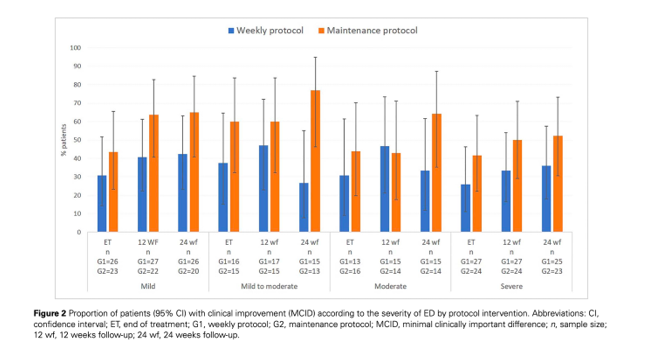
Results: Ninety-three men were allocated to each study group. Median IIEF-EF score at the end of treatment was 21.5 (interquartile range [IQR] 11), at 12 weeks of follow-up was 23 (IQR 12), and at 24 weeks of follow-up was 22 (IQR 10) in the maintenance protocol group, and 20 (IQR 11) at the end of treatment, 20 (IQR 10) at 12 weeks of follow-up, and 18 (IQR 13) at 24 weeks of follow-up in the weekly protocol. No statistically significant differences were found in these comparisons between the groups. In total, 35.8% of patients in the weekly protocol group and 62.8% in the maintenance protocol group achieved the MCID at 24 weeks of follow-up (P-value adjusted = .02). No significant differences were observed between groups in erection hardness or self-esteem outcomes. No serious adverse events were reported in either group.
Clinical implications: A protocol of 6 weekly shockwave sessions plus 5 monthly maintenance sessions may be useful in men with erectile dysfunction, increasing the likelihood of achieving clinical improvement.
Strengths & limitations: Strengths include the sample size, inclusion of men with varying degrees of erectile dysfunction severity, and the randomized clinical trial design. Limitations include the lack of vascular assessment using penile Doppler ultrasound.
Conclusion: The application of a protocol of 6 weekly shockwave therapy sessions plus 5 monthly maintenance sessions, for the treatment of organic erectile dysfunction, does not generate statistically significant changes in the IIEF score up to 6 months of treatment compared to the same protocol without maintenance sessions, but may increase the probability of achieving clinical improvement, without serious adverse events.
Comment Jens Rassweiler
Introduction
Erectile dysfunction (ED) affects a significant portion of the male population, with an estimated prevalence of 24.2%, increasing to 52.2% in men over 75 years old. Current first-line treatment includes phosphodiesterase type 5 inhibitors (PDE5i), but alternative treatments like low-intensity extracorporeal shockwave therapy (Li-ESWT) have gained traction due to their efficacy in treating organic ED. Li-ESWT has been shown to enhance erectile function for up to two years, especially in those who don't respond to PDE5i. This study aims to evaluate the effectiveness of a maintenance schedule of Li-ESWT to preserve the benefits gained from initial treatments.
Material and Methods
Study Design
A multicenter, randomized, open-label trial conducted in Colombia and Mexico from July 2017 to September 2022. The study compared two groups: one receiving a standard protocol of 6 weekly Li-ESWT sessions, and another receiving the same protocol followed by 5 monthly maintenance sessions.
Participants
Men aged 18 years or older diagnosed with organic ED for at least six months were recruited. Key exclusion criteria included severe ED, significant comorbidities, and previous ED treatments within three months prior to enrollment.
Interventions
Participants were randomly assigned to either the weekly protocol or the maintenance protocol. All treatments involved administering shockwave pulses at a specified energy density and frequency: A treatment session consisted of 2000 shockwave pulses delivered along the penile shaft in a sweeping pattern and 1000 pulses applied to the penile crura. Treatments were delivered at an energy density of 0.20 mJ/mm2 and a frequency of 5 Hz u sing the Duolith SD1 T-top device (Storz Medical). The shockwave therapy sessions were performed by the same physiotherapist at each clinic.
Criteria of Outcomes
The primary outcome was the International Index of Erectile Function-Erectile Function (IIEF-EF) score after 24 weeks. Secondary outcomes included the achievement of clinically significant improvement (minimal clinically important difference - MCID), erection hardness, self-esteem scores, and adverse events related to therapy.
Results
A total of 277 patients were included, with 93 in each group. The IIEF-EF scores improved in both groups, but there were no significant differences between the maintenance and weekly protocol groups. However, a higher proportion of patients in the maintenance group achieved the MCID after 24 weeks, suggesting potential benefits from the additional maintenance therapy. If you look at the graph, this is evident.
Discussion
While both protocols improved erectile function, the maintenance therapy yielded a higher likelihood of clinically meaningful improvement. The study hypothesized that periodic maintenance could prolong the biological effects of Li-ESWT. Limitations included lower adherence in the maintenance group and the absence of objective vascular assessments during follow-up. Also, it has to be mentioned, that the authors used only 2000 impulses per session instead of 3000 shocks. It is also interesting, that like in Scandinavia the treatment has been performed by physiotherapist, which we as Urologists should preferably do on our own!
Conclusion
Adding monthly maintenance sessions to a regimen of weekly shockwave therapy does not significantly improve median IIEF-EF scores but may enhance the likelihood of achieving clinical improvements after 24 weeks. Future research is necessary to explore optimal maintenance frequency and its effectiveness in various patient populations, including those with diabetes. This study contributes valuable insights into the management of ED using Li-ESWT and highlights the importance of maintenance therapy in enhancing treatment outcomes.
Jens Rassweiler


Comments