

Sholan R. et al., 2025: Long-Term Prospective Evaluation of Li-ESWT with or without PDE5 Inhibitors for Erectile Dysfunction following Nerve-Sparing Radical Prostatectomy.
Rashad Sholan, Rufat Aliyev, Seymur Karimov, Malahat Sultan, Anar Almazkhanli
Urol Int. 2025 May 11:1-7. doi: 10.1159/000546359. Epub ahead of print.
Abstract
Introduction: Erectile dysfunction (ED) is a common complication following radical prostatectomy (RP). Although phosphodiesterase type 5 inhibitors (PDE5is) are used for penile rehabilitation, their efficacy post-RP is limited. Low-intensity extracorporeal shockwave therapy (Li-ESWT) has emerged as a potential noninvasive treatment, promoting tissue regeneration. This study evaluates the effectiveness of Li-ESWT, with or without PDE5i, for post-RP ED.
Methods: This prospective study included 104 patients who underwent nerve-sparing RP and received Li-ESWT. Patients were divided into two groups: group 1 received daily 5 mg tadalafil along with Li-ESWT, while group 2 received Li-ESWT alone. Erectile function was assessed using the International Index of Erectile Function (IIEF-5) at baseline, 6, 12, and 24 months postoperatively.
Results: The preoperative mean IIEF-5 score was 15.7 ± 4.7, with 54.8% of patients scoring below 17. Postoperatively, significant improvements in IIEF-5 scores were observed at 12 and 24 months in both groups compared to the 6th month. In patients with preoperative IIEF-5 <17, group 1 showed significantly greater improvement in IIEF-5 scores compared to group 2 (p = 0.008). No significant difference was observed between the groups in patients with preoperative IIEF-5 ≥17 (p = 0.893).
Conclusion: Li-ESWT is an effective treatment for ED following nerve-sparing RP, with or without PDE5i. In patients with mild-to-moderate or greater preoperative ED, the combination of PDE5i and Li-ESWT may provide additional benefits, whereas Li-ESWT alone appears sufficient for those with milder cases.
Comment Jens Rassweiler
Introduction: Erectile dysfunction (ED) is a common complication after radical prostatectomy (RP) for localized prostate cancer, affecting a significant percentage of men, despite the nerve-sparing techniques used. Current treatments include phosphodiesterase type 5 inhibitors (PDE5is), but their effectiveness is often limited. Low-intensity extracorporeal shock wave therapy (Li-ESWT) is emerging as a noninvasive treatment option that may improve ED recovery through promoting tissue regeneration and vascularization.
Study Design: This prospective study evaluated the efficacy of Li-ESWT for ED following nerve-sparing RP in Azerbaijan, involving patients who underwent surgery between October 2017 and November 2023. Patients were divided into two groups: one receiving daily tadalafil (a PDE5i) with Li-ESWT, and the other receiving Li-ESWT alone.
In the group receiving PDE5i, daily 5 mg tadalafil was initiated in the third postoperative week. Li-ESWT (DUOLITH® SD1 T-TOP, Storz Medical AG, Tägerwilen, Switzerland) was started 2 months postoperatively, with a total of 12 sessions performed twice weekly. A total of 3,000 shockwaves were applied at an energy density of 0.25 mJ/ mm2 and an emission frequency of 6 Hz,
Key exclusion criteria included previous penile procedures and severe comorbidities. The IIEF-5 score was used to assess erectile function at multiple time points postoperatively.
Results: A total of 104 patients were included.Baseline characteristics were similar across groups.
- The IIEF-5 scores significantly dropped postoperatively at the 6-month mark before showing improvement at 12 and 24 months.
- Although improvements were seen in both groups, there was no statistically significant difference in IIEF-5 score changes between the group receiving PDE5i and Li-ESWT and the group that received Li-ESWT alone.
- In patients with preoperative IIEF-5 scores less 17, Li-ESWT combined with PDE5i showed greater improvements compared to Li-ESWT alone.
Thus, the efficacy of the combined treatment depends on the prepoperative status of erectile function.
Discussion: Li-ESWT demonstrated effectiveness in improving erectile function post-RP, particularly among patients with more severe preoperative ED. The study highlights the potential of Li-ESWT as part of a penile rehabilitation strategy, especially in settings where advanced surgical options like robotic-assisted surgeries are unavailable.
Limitations: The study’s limitations include a relatively small sample size (N=104) and most importantly the lack of randomization, which may bias the results. Larger studies with more diverse cohorts are needed to further validate these findings.
Conclusions: Li-ESWT, with or without PDE5 inhibitors, appears to be a beneficial treatment for ED following nerve-sparing RP, particularly for patients with mild to moderate preoperative erectile issues. Continued exploration of long-term outcomes and larger trials will help establish its efficacy in this context.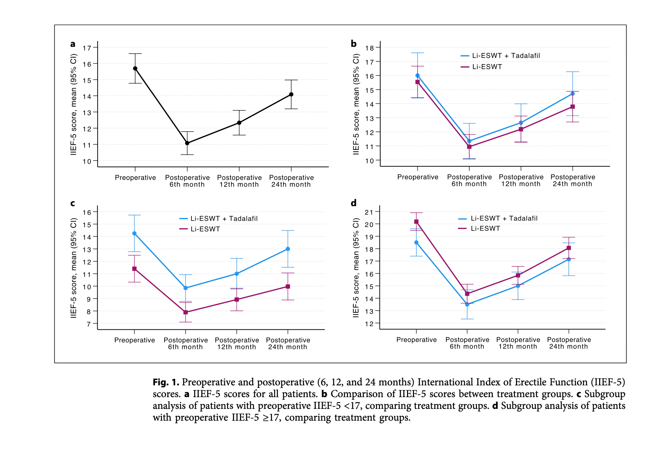
Jens Rassweiler


Comments