
Ufondu W, Ogunsola O, Williams A, Valenti K, Herbert G, Ezenekwe E, Bufano J, Suleiman T, Esiso F, Jevotovsky D, Hasoon J, Orhurhu V.
Orthop Rev (Pavia). 2026 Aug 10;18:154361. doi: 10.52965/001c.154361
Abstract
Purpose of review: The purpose of this narrative review is to explain the cellular mechanisms behind chronic pain, the mechanisms behind extracorporeal shockwave therapy, and its efficacy for the treatment of various chronic pain conditions including tendinopathies, greater trochanteric pain, de quervain tenosynovitis, myofascial pain, plantar fasciitis, fibromyalgia, osteoarthritis, fractures, osteonecrosis, bone edema, coccydynia, low back pain, chronic pelvic pain syndrome/chronic prostatitis, ulcers, and carpal tunnel syndrome.
Recent findings: Many recent clinical trials and meta-analyses from the year 2024 overall supported the efficacy of extracorporeal shockwave therapy for the treatment of chronic pain conditions with minimal adverse effects.
Summary: Extracorporeal shockwave therapy is a novel technique that uses mechanotransduction to induce a cellular response that prevents central sensitization, reduces inflammation, and contributes to healing that alleviates pain. The specific mechanisms through which extracorporeal shockwave therapy are largely unknown or poorly understood. A literature search of Scopus, PubMed, Embase, and the Cochrane Database of Systematic Reviews was conducted to identify 84 studies from 2000-2024 evaluating the efficacy of extracorporeal shockwave therapy for the treatment of chronic pain conditions. The results indicate that extracorporeal shockwave therapy holds strong promise for the treatment of numerous chronic pain pathologies with minimal adverse effects and should be studied further.
Comment Jens Rassweiler
This narrative review examines extracorporeal shockwave therapy (ESWT), a non-invasive treatment that delivers mechanical waves to tissue, as a possible option for chronic pain. The authors searched four databases for studies published from 2000 to July 2024 and included 84 studies—randomized trials, follow-ups, systematic reviews, and meta-analyses—covering a wide range of conditions.
Proposed Mechanism
The proposed explanation is that shockwaves trigger mechanotransduction: physical forces prompt cellular and biochemical responses that may reduce inflammation, influence pain signaling, encourage blood-vessel formation, and support tissue repair. The review discusses possible roles for nitric oxide, nerve signaling, macrophage activity, and MAPK pathways. These mechanisms remain incompletely understood, and it is not established that ESWT prevents central sensitization in patients.
Results
Overall, the review reports promising pain outcomes and few serious adverse effects, but results vary by condition:
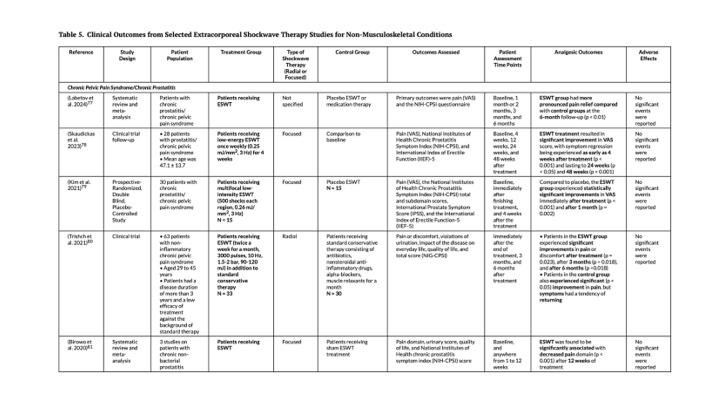
- More encouraging evidence is described for plantar fasciitis, lateral epicondylitis, some shoulder tendinopathies, myofascial pain, knee osteoarthritis, low-back pain, and chronic pelvic pain/prostatitis.
- Mixed or limited evidence is reported for Achilles tendinopathy, greater trochanteric pain, fibromyalgia, and ulcers.
- For several other conditions—including de Quervain tenosynovitis, coccydynia, fractures, osteonecrosis, and bone edema—the review found relatively few studies, so confidence is limited.
The duration of benefit also differs across conditions. Many studies report short- or medium-term improvements; claims of longer-lasting benefit are supported for some conditions but should not be generalized to all ESWT treatments.
Discussion
Strengths of the study
- Broad coverage of both musculoskeletal and non-musculoskeletal pain conditions.
- Explains the biological rationale as well as the clinical findings.
- Includes recent trials and meta-analyses and notes where the evidence is conflicting.
- Addresses treatment variations, such as focused versus radial shockwaves, and reports adverse effects.
Limitations of the study
- It is a narrative review, not a formal pooled analysis. The article does not report a combined effect estimate across studies.
- The search and screening approach is described, but the excerpt does not report a formal risk-of-bias assessment or an overall certainty rating for each condition.
- Studies vary in diagnosis, treatment settings, device type, dose, comparison group, and follow-up period. This makes broad conclusions difficult.
- Some conditions are represented by only one or a handful of studies.
- The search ended in July 2024, so it may not include later evidence available by the article’s 2026 publication.
- Evidence that ESWT can improve pain does not by itself prove the proposed cellular mechanisms or establish that it works better than standard care.
Conclusions
ESWT appears to be a promising, generally well-tolerated option for some chronic pain conditions, but the strength of evidence is condition-specific. The review supports further research—not the conclusion that ESWT is established or equally effective across the many conditions discussed. It is also important to note, that the article did only took chronic pelvic pain out of the range of indications for pain management in Urology.
Jens Rassweiler