

Wang H, Li C, Zhang T, Li S. et al., 2026: From symptomatic relief to restorative medicine: a comprehensive review of diabetic erectile dysfunction.
Wang H, Li C, Zhang T, Li S.
Transl Androl Urol. 2026 Mar 15;15(3):88. doi: 10.21037/tau-2025-1-945. Epub 2026 Feb 26.
Abstract
Diabetic erectile dysfunction (DMED) represents one of the most prevalent and debilitating complications in men with diabetes, characterized by a complex multifactorial pathogenesis and often suboptimal response to conventional therapies. This review comprehensively summarizes the current understanding of DMED mechanisms and evaluates the evolving therapeutic landscape. We highlight oxidative stress as a pivotal central hub triggered by hyperglycemia, which orchestrates a cascade of detrimental events. Beyond classical endothelial dysfunction and RhoA/ROCK pathway activation, we discuss emerging pathogenic targets, including the activation of the NOD-like receptor pyrin domain-containing protein 3 (NLRP3) inflammasome leading to pyroptosis, ferroptosis-induced smooth muscle loss, and epigenetic dysregulation (e.g., upregulated miR-155). Furthermore, the "gut-penis axis" is explored as a novel link between microbiota dysbiosis and systemic inflammation affecting erectile function. Critically, this review assesses the paradigm shift from symptomatic management to restorative therapies. While phosphodiesterase type 5 inhibitors (PDE5i) remain the first-line treatment, they exhibit a non-response rate of approximately 40-50% in diabetic men due to severe neuropathy and endothelial damage. Consequently, emerging regenerative modalities are gaining prominence. We evaluate the efficacy of low-intensity extracorporeal shockwave therapy (Li-ESWT) in promoting angiogenesis and the strategic transition from stem cell transplantation to cell-free exosome therapies to overcome immunogenicity. Additionally, novel pharmacotherapies such as sodium-glucose cotransporter-2 (SGLT2) inhibitors are discussed for their potential to reduce sympathetic overactivation. Finally, we propose a comprehensive, stepwise clinical management algorithm-ranging from metabolic optimization to regenerative interventions and penile prostheses-to achieve personalized precision medicine for refractory DMED patients.
Comment Jens Rassweiler
This review argues that diabetic erectile dysfunction is driven largely by hyperglycemia-induced oxidative stress, endothelial dysfunction, neuropathy, fibrosis, inflammation, and endocrine/psychological factors. It emphasizes a shift from symptomatic PDE5 inhibitor therapy toward restorative approaches such as Li-ESWT, stem cells, exosomes, SGLT2 inhibitors, GLP-1 receptor agonists, and penile prosthesis implantation for refractory cases.
Critical appraisal: Shock wave therapy in diabetic erectile dysfunction
The review presents low-intensity extracorporeal shock wave therapy as a promising restorative treatment for diabetic erectile dysfunction, moving beyond purely symptomatic therapies such as phosphodiesterase type 5 inhibitors. This is a relevant focus because diabetic erectile dysfunction is often more severe, more treatment-resistant, and more strongly linked to vascular and neuropathic damage than erectile dysfunction in the general population.
Strengths of the discussion
One strength is that the review places shock wave therapy within the broader pathophysiology of diabetic erectile dysfunction. Diabetes contributes to erectile dysfunction through endothelial dysfunction, impaired nitric oxide signalling, oxidative stress, microvascular disease, smooth muscle damage, fibrosis, and neuropathy. Shock wave therapy is therefore discussed as a potentially disease-modifying intervention because it may improve penile blood flow, stimulate angiogenesis, enhance endothelial function, and promote tissue repair.
This is an important distinction from PDE5 inhibitors, which mainly enhance erectile response temporarily but do not directly reverse underlying diabetic vascular damage. In men with diabetes, particularly those with poor response to PDE5 inhibitors, the idea of a regenerative or restorative treatment is clinically attractive.
The review also appropriately highlights shock wave therapy as minimally invasive and generally well tolerated. Compared with intracavernosal injections or penile prosthesis surgery, shock wave therapy has a favourable acceptability profile. This could make it appealing for diabetic patients who are not ready for invasive options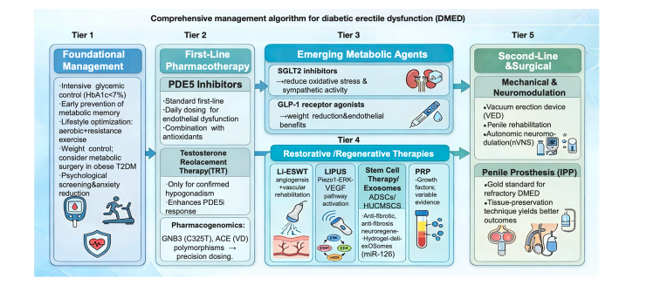
Limitations of the evidence
However, the strength of evidence for shock wave therapy in diabetic erectile dysfunction remains limited. Much of the available research on shock wave therapy involves mixed erectile dysfunction populations, rather than trials focused exclusively on diabetic men. This matters because diabetic erectile dysfunction has distinct mechanisms and is often more advanced. Results from broader vasculogenic erectile dysfunction populations may not be fully generalisable to diabetic patients.
Another limitation is heterogeneity in treatment protocols. Studies vary in the number of sessions, shock wave energy settings, anatomical treatment sites, total pulses delivered, treatment duration, and follow-up length. This makes it difficult to determine the optimal regimen or to compare outcomes across studies. The review would be stronger if it more clearly distinguished between different protocols and commented on which approaches appear most evidence-based.
There is also uncertainty about durability of benefit. Some studies suggest improvement in erectile function scores after therapy, but long-term maintenance of effect is less well established. For diabetic patients, who often have ongoing vascular and metabolic injury, the durability of tissue-level improvement is especially important. Without longer follow-up, it is difficult to know whether shock wave therapy provides sustained restoration or only temporary improvement.
Clinical significance
The review appears to treat shock wave therapy as a promising restorative option, but the magnitude of clinical benefit should be interpreted cautiously. Improvements in International Index of Erectile Function scores may be statistically significant, but may not always translate into meaningful functional recovery for all patients. In diabetic men with severe erectile dysfunction, advanced neuropathy, poor glycaemic control, hypogonadism, or significant penile fibrosis, shock wave therapy alone may be insufficient.
The therapy may be most suitable for men with mild to moderate vasculogenic diabetic erectile dysfunction, especially those with partial response to PDE5 inhibitors. Its role in severe diabetic erectile dysfunction or complete PDE5 inhibitor non-response remains less certain.
Safety and tolerability
A positive aspect is the apparent safety of low-intensity shock wave therapy. Reported adverse effects are usually minimal, such as mild discomfort or local irritation. This is particularly relevant in diabetic patients, who may have higher surgical risks and comorbid cardiovascular disease.
However, the review should be careful not to overstate safety simply because short-term adverse events are rare. Long-term safety data, repeated treatment cycles, and outcomes in patients with advanced diabetic complications remain less well defined.
Mechanistic plausibility
The proposed mechanisms are biologically plausible. Shock wave therapy may induce microtrauma that stimulates angiogenic factors, endothelial repair, neovascularisation, and recruitment of regenerative cells. These effects align with the vascular pathology of diabetic erectile dysfunction.
However, mechanistic plausibility does not automatically prove clinical effectiveness. Diabetes creates a hostile metabolic environment characterised by oxidative stress, inflammation, and impaired healing. Therefore, even if shock wave therapy stimulates regenerative pathways, these effects may be blunted in poorly controlled diabetes. The review could have placed more emphasis on patient selection, glycaemic control, and disease severity as likely modifiers of response.
Conclusions
Overall, the review presents shock wave therapy as a promising but still incompletely validated treatment for diabetic erectile dysfunction. Its main appeal is that it may target underlying vascular dysfunction rather than simply providing symptomatic relief. It is non-invasive, generally safe, and mechanistically plausible.
However, the evidence base remains limited by small studies, heterogeneous protocols, short follow-up periods, and insufficient diabetic-specific trial data. At present, shock wave therapy should probably be viewed as an emerging adjunctive treatment rather than an established standard therapy for diabetic erectile dysfunction. It may be reasonable in selected patients, particularly those with vasculogenic disease and inadequate response to oral therapy, but stronger randomised controlled trials in diabetic populations are needed before firm clinical recommendations can be made.
In summary, the review is useful in identifying shock wave therapy as part of the shift toward restorative medicine, but it should be interpreted cautiously. The treatment is promising, but not yet definitively proven for diabetic erectile dysfunction.
Jens Rassweiler


Comments