

Wu MJ. et al., 2026: Optimizing the Use of Extracorporeal Shock Wave Therapy for CP/CPPS: A Modality-Based Systematic Review and Meta-Analysis Comparing Focused and Radial Devices.
Wu MJ, Kao CC, Yang MH, Tsao CW, Chen CL.
J Clin Med. 2026 Feb 5;15(3):1270. doi: 10.3390/jcm15031270
Abstract
Background/Objectives: Chronic prostatitis/chronic pelvic pain syndrome (CP/CPPS) is a multifactorial condition often refractory to standard medical therapy. Low-intensity extracorporeal shock wave therapy (Li-ESWT) is a mechanism-oriented option; however, prior reviews reported substantial heterogeneity, potentially due to pooling different wave-generator modalities despite their distinct physical properties. This study synthesized randomized evidence on Li-ESWT for CP/CPPS and explored a wave-generator modality as a prespecified effect modifier. Methods: PubMed, Embase, Web of Science, and the Cochrane Library were searched from January 2015 to 31 October 2025 (date of last search) for randomized controlled trials (INPLASY: 2025120064). Eligible studies compared Li-ESWT (focused, radial, or multifocal) with sham or standard medical therapy (SMT). The primary outcome was total NIH-CPSI at the follow-up closest to 12 weeks. Pooled effects were calculated as weighted mean differences (WMDs) with 95% confidence intervals (CIs). Prespecified subgroup analyses were performed by wave-generator modality and therapy strategy (monotherapy vs add-on to SMT). Results: Eight RCTs (n = 455) were included. Li-ESWT significantly improved total NIH-CPSI versus the control (WMD -8.46; 95% CI -12.12 to -4.79; I2 = 94.8%). Benefits were observed in both monotherapy and the add-on to SMT trials. By modality, focused devices showed consistent effects (WMD -6.59; I2 = 0.0%), whereas radial devices showed an imprecise estimate with extreme heterogeneity (WMD -10.38; 95% CI -21.33 to +0.57; I2 = 98.2%). Multifocal devices showed a significant benefit (WMD -10.84; I2 = 81.0%). Improvements were mainly driven by pain-domain reduction. Conclusions: Li-ESWT provides clinically meaningful symptom relief in CP/CPPS, predominantly through pain reduction. Modality- and strategy-based subgroup findings are exploratory given substantial heterogeneity, limited trials, and no head-to-head comparisons; focused devices showed consistent effects, whereas estimates for radial and multifocal devices warrant cautious interpretation.
Comment Jens Rassweiler
Research Question
This systematic review and meta-analysis evaluated whether low-intensity extracorporeal shock wave therapy, Li-ESWT, improves symptoms in men with chronic prostatitis/chronic pelvic pain syndrome, CP/CPPS, and whether treatment effects differ by shock wave generator type: focused, radial, or multifocal.
Methods
The authors searched PubMed, Embase, Web of Science, and the Cochrane Library for randomized controlled trials from January 2015 to 31 October 2025. Eight RCTs involving 455 participants were included. Eligible trials compared:
- Li-ESWT versus sham therapy, or
- Li-ESWT plus standard medical therapy versus standard medical therapy alone.
The primary outcome was the total NIH-CPSI score at the follow-up closest to 12 weeks. Subgroup analyses were prespecified by:
- Wave-generator modality: focused, radial, multifocal
- Treatment strategy: monotherapy versus add-on to standard medical therapy
Random-effects meta-analysis was used, and certainty of evidence was assessed with GRADE (Grading of Recommendations Assessment, Development and Evaluation).
Results
Li-ESWT significantly improved total NIH-CPSI scores compared with control treatment.
Overall effect:
- WMD (weighted mean difference): −8.46 points (95% CI: −12.12 to −4.79; p < 0.001; I² = 94.8%)
This improvement exceeds the commonly cited minimal clinically important difference of approximately 4–6 NIH-CPSI points, suggesting clinical relevance. However, heterogeneity was very high, meaning the size of benefit varied substantially across studies.
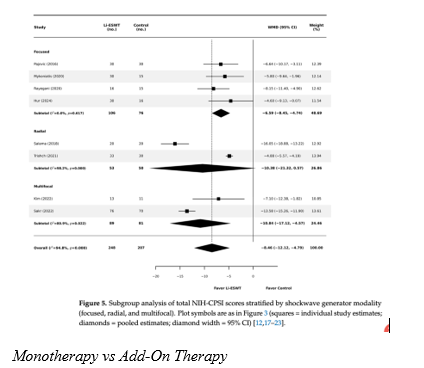
Focused vs Radial vs Multifocal Devices
Focused devices showed the most consistent evidence.
- Trials: 4
- WMD: −6.59 (95% CI: −8.45 to −4.74; I² = 0.0%)
This suggests a reliable and clinically meaningful improvement in total NIH-CPSI scores.
Radial devices showed a larger numerical effect, but the estimate was highly uncertain.
- Trials: 2
- WMD: −10.38 (95% CI: −21.33 to +0.57; I² = 98.2%; p = 0.063)
Because the confidence interval crossed zero and heterogeneity was extreme, the radial-device evidence is inconclusive.
Multifocal devices showed significant benefit but with substantial heterogeneity.
- Trials: 2
- WMD: −10.84 (95% CI: −17.12 to −4.57; I² ≈ 81%)
This suggests possible benefit, but the certainty is limited.
Li-ESWT was beneficial both as monotherapy and as an add-on to standard medical therapy.
Monotherapy: Trials: 5; WMD: −9.76; I² = 88.5%
Add-on to standard medical therapy: Trials: 3; WMD: −6.05; I² = 55.5%
Both strategies showed significant improvement, but the results should not be interpreted as proving that monotherapy is superior to add-on therapy because the included studies differed in design, protocols, and comparators.
Domain-Specific Effects
The benefit of Li-ESWT appeared to be driven mainly by pain reduction.
Pain domain: WMD: approximately −4.03; Significant improvement; ² = 87.7%
Urinary domain: WMD: −0.20; 95% CI: −1.22 to 0.83; No significant improvement
This suggests Li-ESWT may be more useful as a pain-modulating intervention than as a treatment for urinary symptoms.
Safety
Li-ESWT appeared generally well tolerated. No serious treatment-related adverse events were reported in the included RCTs. Reported adverse events were mild and self-limiting, including:
- Transient hematuria
- Hematospermia
- One case of first-degree skin burn resolving within one week
However, safety reporting was not uniform, and long-term safety data remain limited. Nevertheless, actually there are no serious reports in the literature!
Certainty of Evidence
The overall certainty of evidence was rated as low because of:
- Substantial heterogeneity
- Limited number of trials
- Some risk-of-bias concerns
- Possible publication bias
- Lack of direct head-to-head device comparisons
By modality:
- Focused devices: moderate certainty
- Multifocal devices: low certainty
- Radial devices: very low certainty
Discussion
Li-ESWT appears to provide clinically meaningful symptom relief for men with CP/CPPS, mainly by reducing pain. The most consistent evidence supports focused Li-ESWT. Radial and multifocal devices may also be beneficial, but their evidence is less stable because of small trial numbers and high heterogeneity. This seems to be understandable because of the better location tracking of the focused devices.
Li-ESWT should probably be viewed as part of a multimodal CP/CPPS management strategy rather than as a definitive stand-alone cure.
Limitations
- Only eight RCTs were included.
- Heterogeneity was very high in the overall analysis.
- There were no direct head-to-head trials comparing focused, radial, and multifocal devices.
- Treatment protocols varied in energy level, number of sessions, and follow-up duration.
- Blinding and allocation concealment were unclear in several trials.
- Long-term durability of benefit remains uncertain (ie. maintenance therapy).
- Evidence for radial and multifocal devices is based on only two trials each.
Conclusion
Li-ESWT is a promising nonpharmacologic treatment for CP/CPPS, with clinically meaningful improvement mainly through pain reduction, and focused devices currently have the most consistent supporting evidence.
Jens Rassweiler


Comments