

Wu ML. et al., 2026: The therapeutic effect and mechanism of low-intensity pulsed ultrasound for erectile dysfunction.
Mei-Li-Yang Wu, Wen-Chao Xu, Tao Wang, Ji-Hong Liu, Hao Li
Androl. 2026 Mar 13. doi: 10.4103/aja2025110 FREE ARTICLE
Abstract
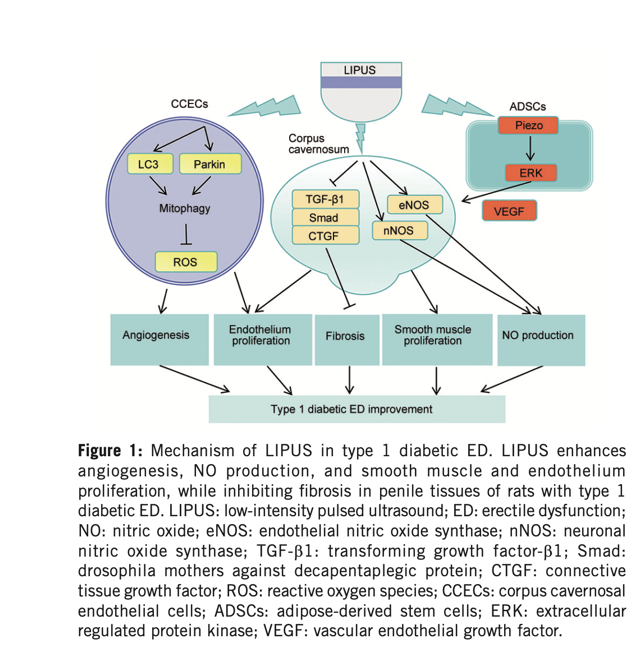
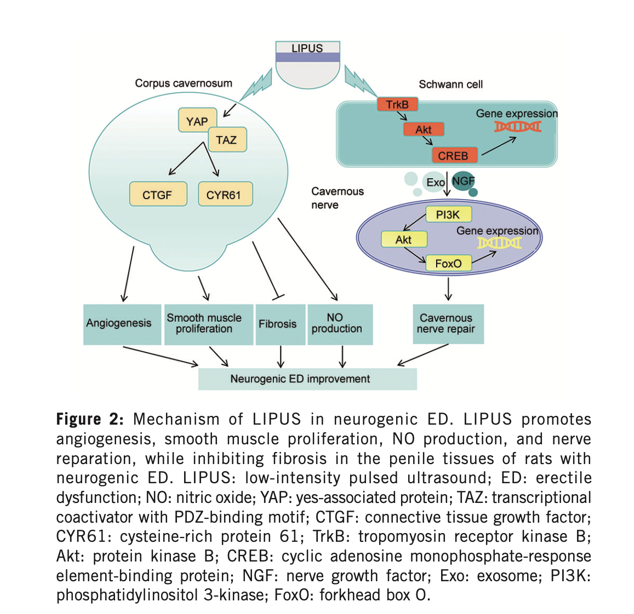
As an emerging therapeutic option for erectile dysfunction (ED), low-intensity pulsed ultrasound (LIPUS) has attracted increasing attention. The therapeutic effect of LIPUS is comparable to low-intensity extracorporeal shockwave therapy. However, the underlying mechanism of LIPUS remains unclear. We summarized the current literature to assess the efficacy of LIPUS for ED and elucidate the biological effects caused by LIPUS in different ED models. Preliminary clinical studies demonstrate that LIPUS is beneficial for ED with varying degrees of severity, and its therapeutic effect can be enhanced when combined with phosphodiesterase 5 inhibitors. Basic researches have shown that LIPUS can treat ED resulting from type 1 diabetes mellitus, cavernous nerve injury, or cavernosa injury. The underlying mechanisms involve upregulating endothelial and neuronal nitric oxide synthase expression, increasing smooth muscle and endothelium content, inhibiting cavernosal fibrosis mediated by the transforming growth factor-β1/drosophila mothers against decapentaplegic protein/connective tissue growth factor (TGF-β1/Smad/CTGF) pathway, and ameliorating oxidative stress via microtubule-associated protein 1 light chain 3 (LC3)- and Parkin-dependent mitophagy in type 1 diabetic ED. Yes-associated protein (YAP) and transcriptional coactivator with PDZ-binding motif (TAZ), activated by LIPUS, contribute to the recovery of neurogenic ED. Furthermore, the survival and secretion function of Schwann cells are improved by LIPUS through activating tropomyosin receptor kinase B/protein kinase B/cyclic adenosine monophosphate-response element-binding protein (TrkB/Akt/CREB) pathway, thereby accelerating cavernous nerve repair. LIPUS is a safe and effective treatment modality for ED, which can restore the pathological changes in corpus cavernosum via multiple pathways. The long-term efficacy of LIPUS needs further investigation.
Comment Jens Rassweiler
Introduction
This article reviews the therapeutic effects and underlying mechanisms of low-intensity pulsed ultrasound (LIPUS) for treating erectile dysfunction (ED). ED is a complex condition often caused by factors such as diabetes, pelvic surgery, and vascular issues, leading to problems like endothelial dysfunction and cavernosal fibrosis. While phosphodiesterase type 5 inhibitors (PDE5is) are commonly used for treatment, they are not effective for all patients, prompting interest in alternative therapies like LIPUS.
LIPUS operates by inducing microturbulence in cellular fluids through acoustic waves, facilitating biological effects similar to low-intensity extracorporeal shock wave therapy (LIESWT). The article explores various studies indicating LIPUS can improve erectile function, particularly in patients with diabetic ED and those with other underlying conditions.
Clinical Trials
Clinical trials have demonstrated that LIPUS can significantly enhance erectile function, with response rates varying between 36% to 76%. The therapy is generally more effective when combined with PDE5is or other treatments, and the optimal treatment frequency appears to be twice weekly. However, the studies conducted thus far have limitations, including short follow-up periods and variability in treatment parameters.
Mechanisms of LIPUS
The mechanisms by which LIPUS exerts its effects involve several biological pathways. In diabetic ED models, LIPUS has been shown to upregulate endothelial nitric oxide synthase (eNOS), reduce cavernosal fibrosis, and enhance mitochondrial function through processes like mitophagy. For neurogenic ED, LIPUS may activate the YAP/TAZ signaling pathway, promoting nerve repair and regeneration.
Differences between LIPUS and LI-ESWT
Low-Intensity Pulsed Ultrasound (LIPUS) and Low-Intensity Extracorporeal Shock Wave Therapy (LI-ESWT) are both forms of microenergy treatments used in various therapeutic applications, including the treatment of erectile dysfunction (ED), but they have distinct physical properties and mechanisms of action. Key differences include
1. Type of Wave:
- LIPUS utilizes acoustic waves that are continuous and pulsed at low intensities, typically with frequencies ranging from 0.7 to 3 MHz. The mechanical vibrations produced by LIPUS induce microturbulence in intercellular fluids.
- LI-ESWT: Employs shock waves, which are high-pressure pulses that create a rapid increase in pressure followed by a rapid drop. The waves generated by LIESWT are characterized by a low frequency (usually 2-8 Hz) and a low energy level (0.1-0.3 mJ/mm²).
2. Mechanism of Action
- LIPUS primarily works through micromechanical vibrations and acoustic cavitation, which can stimulate cellular processes such as proliferation, differentiation, and tissue repair. It has been shown to enhance the healing of tissues by promoting angiogenesis and reducing inflammation.
- LI-ESWT functions mainly through the mechanical stress and cavitation effects of shock waves. LIESWT is known to activate several biological responses, including the recruitment of progenitor cells, enhancement of microcirculation, and induction of angiogenesis.
3. Thermal Effects
- LIPUS generates minimal thermal effects due to its low intensity and pulsed output mode. The focus is primarily on non-thermal mechanical effects on tissues.
- LI-ESWT: The shock waves may have a more considerable mechanical force but also cause some thermal effects, though these are generally not the primary focus of treatment.
4. Clinical Applications
- LIPUS was initially used in rehabilitation medicine for bone healing and soft tissue repair, LIPUS has been explored for conditions like ED, where it has shown potential in improving erectile function.
- LI-ESWT is more widely recognized in the treatment of ED and other conditions such as musculoskeletal disorders. It has a more established protocol and clinical evidence supporting its use specifically for ED.
5. Treatment Protocols
- LIPUS: Treatment frequencies and parameters can vary widely, typically administered at lower intensities and with different pulsing techniques.
- LI-ESWT generally involves specific standardized treatment protocols, often with set energy levels and frequencies, and is commonly administered in series over several weeks.
While both LIPUS and LI-ESWT are promising therapeutic modalities, they differ in their wave characteristics, mechanisms of action, and clinical applications. LIPUS focuses on low-intensity ultrasound waves and mechanical effects, while LI-ESWT utilizes high-pressure shock waves and is more established in clinical practice for certain conditions, including erectile dysfunction.
Conclusion
In conclusion, while LIPUS shows promise as a non-invasive treatment for ED, further high-quality clinical trials and research are necessary to establish its long-term efficacy and optimal treatment protocols. The article emphasizes the need for more comprehensive studies, particularly concerning its effects on various types of ED and the underlying molecular mechanisms involved.
Jens Rassweiler


Comments