

Zhang H. et al., 2026: Efficacy of the new P100 extracorporeal shock wave therapy device in the treatment of type IIIB chronic prostatitis/chronic pelvic pain syndrome: a sham treatment controlled, prospective clinical trial.
Zhang H, Song W, Ni J, Zhang H, Jiang Z, Yang G, Zhang Y, Wang K, Chen Y, Peng B
Prostate Cancer Prostatic Dis. 2026 Jan 28. doi: 10.1038/s41391-026-01072-0
Abstract
Objective: To evaluate the therapeutic efficacy and clinical applicability of the novel P100 extracorporeal shock wave therapy (ESWT) device in the treatment of type IIIB chronic prostatitis/chronic pelvic pain syndrome (CP/CPPS).
Methods: In this randomized, single-blind, sham-controlled trial, 83 patients with type IIIB CP/CPPS were enrolled and randomly assigned to either the P100 treatment group (n = 51) or the control group (n = 32). Patients in the treatment group received four weekly low-intensity ESWT sessions (0.2 mJ/mm²), while the control group received identical procedures with shock transmission blocked. The primary endpoint was the clinical response rate (≥6-point reduction in NIH-CPSI score) at week 4; week 8 outcomes were further analyzed to assess sustained efficacy. Secondary endpoints included IPSS, IIEF-5, and VAS scores.
Results: At week 4, the clinical response rate was 78.4% in the P100 group compared with 25% in the control group (P < 0.001). Median NIH-CPSI scores decreased from 35 at baseline to 13 at week 4 and 12 at week 8, indicating sustained improvement. Significant reductions in PDS, IPSS, and VAS scores were observed as early as week 2 (P < 0.05), and symptom relief remained stable through week 8 without rebound. Exploratory analyses suggest that lower baseline estradiol levels and lower E2/T ratios may be associated with more sustained improvements in erectile function. No treatment-related adverse events were reported.
Conclusion: The P100 ESWT device provided rapid, significant, and sustained symptom relief for type IIIB CP/CPPS, particularly in pain and urinary domains. Hormonal balance (E2/T) may influence the long-term maintenance of erectile function after ESWT. These findings support P100 as a safe and effective non-invasive therapeutic option for CP/CPPS, warranting further validation in larger studies with longer-term follow-up.
Comment Jens Rassweiler
Objective
The study aimed to determine whether the P100 low-intensity shock wave device could improve symptoms in men with non-inflammatory CP/CPPS type IIIB, especially pelvic pain, urinary symptoms, and sexual function.
Methods
Device: P100 is a focal shock wave device using piezo-electric crystalls for shock wave generation in a self-focussing applicator applying 2000 pulses per session (0.2m/mm2 at 3 Hz)
Participants: 83 men with type IIIB CP/CPPS completed the trial. P100 treatment group: 51 patients; Sham/control group: 32 patient
Treatment: Patients received 4 weekly sessions. Treatment group: low-intensity ESWT at 0.2 mJ/mm². Control group: same procedure, but shock transmission was blocked
Primary endpoint: Clinical response at week 4, defined as a ≥6-point reduction in NIH-CPSI score. Follow-up: Outcomes were also assessed at week 8.
Measures used: NIH-CPSI, IPSS, IIEF-5, VAS, pain/discomfort scores, urinary symptom scores.
Results
Clinical outcome
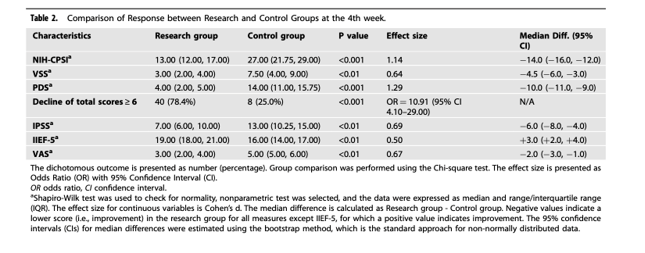
At week 4: Clinical response rate was: 78.4% in the P100 group vs. 25% in the sham group. The difference was statistically significant: P < 0.001
NIH-CPSI scores improved substantially:
Baseline median NIH-CPSI: about 35; at week 4: 13, at week 8: 12
This suggests that symptom improvement was not only rapid but also maintained through the 8-week follow-up.
The P100 group also showed significant improvements in:
- Pelvic pain/discomfort
- Urinary symptoms
- IPSS scores
- VAS pain scores
- Some improvement in erectile function scores
Pain and urinary symptoms improved as early as week 2. The study found that erectile function improved at week 4, but this improvement was less stable by week 8.
Exploratory subgroup analysis suggested that patients with:
- Lower baseline estradiol levels
- Lower estradiol/testosterone ratio, or E2/T ratio
may have had more sustained erectile function improvement.
However, the authors emphasized that this finding is exploratory and needs confirmation in larger studies.
Safety
No treatment-related adverse events were reported. The P100 device was described as safe and well tolerated.
Conclusion
The study concluded that the P100 ESWT device provided rapid, significant, and sustained improvement in men with type IIIB CP/CPPS, especially for pain and urinary symptoms.
The benefits lasted at least 8 weeks after treatment began. The device appears to be a safe, non-invasive treatment option, but larger studies with longer follow-up are needed to confirm long-term effectiveness.
Key Takeaway
The P100 shock wave therapy device may be an effective non-drug, non-invasive treatment for non-inflammatory chronic prostatitis/chronic pelvic pain syndrome, particularly for relieving pelvic pain and urinary discomfort.
Jens Rassweiler


Comments