

Abdallah M. et al., 2025: Effectiveness and safety of ultra-slow full power shockwave lithotripsy compared to mini-percutaneous nephrolithotomy and retrograde intrarenal surgery for treatment of lower calyceal stone between 1 and 2 cm with high attenuation value.
Mahmoud Abdallah, Mohammad Talaat Mohammad, Ahmed M Ragheb, Akrm A Elmarakbi, Ossama Mahmoud
World J Urol. 2025 Nov 11;43(1):688. doi: 10.1007/s00345-025-06004-6 FREE TEXT
Abstract
Purpose: This prospective randomized study compared the effectiveness and safety of ultra-slow full power shockwave lithotripsy (ultraslow SWL), mini-percutaneous nephrolithotomy (mini-PNL), and retrograde intrarenal surgery (RIRS) for 1-2 cm lower calyceal stone with HU above 1000.
Methods: 360 patients were randomized with stratification according to stone size using a block randomization to: (1) Ultraslow SWL; (2) Mini-PNL; or (3) RIRS. Primary outcomes were stone-free rates (SFR) and complications with blinding of assessors. Our follow-up protocol featured a non-contrast CTUT after 3 months for Ultraslow SWL while 1 month for both mini-PNL and RIRS groups, confirming stone-free status. The SFR was stratified as follow: true stone-free (0 mm), residual fragments ≤ 2 mm, residual fragments 3-4 mm, and failure (more than 4 mm). Secondary outcomes included operative parameters and hospitalization. Multinominal logistic regression was used for significant findings to identify predictors of success or failure.
Comment Hans-Göran Tiselius
This article describes the effect of SWL, mini-PNL and RIRS for treatment of lower calyx stones.
Most interesting is that the authors used ultraslow SWL, not commonly encountered in the literature.
Shock waves were delivered at a rate of 30 per minute with up to 2500-3000 sw. With this method there is a complete disappearance of cavitation between the shocks. Reduced tissue injury by the slow rate of SWL results in minimal trauma. The effects of SWL were further increased by a wide focal zone.
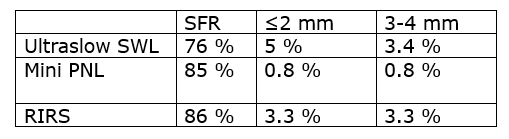
It is disappointing that the ultraslow SWL was not more successful.
Hans-Göran Tiselius


Comments