



Haas CR. et al., 2022: Ureteroscopy and Shock Wave Lithotripsy Trends from 2012 to 2019 Within the US Medicare Dataset: Sharp Growth in Ureteroscopy Utilization.
Haas CR, Li S, Knoedler MA, Penniston KL, Nakada SY.
J Endourol. 2022 Nov 3. doi: 10.1089/end.2022.0402
Abstract
Introduction and Objective: Both ureteroscopy (URS) and shock wave lithotripsy (SWL) are cornerstones in the surgical management of urolithiasis in the United States. We hypothesized that URS utilization outpaced SWL utilization in recent years and quantified the magnitude of change over time for caseloads of URS and SWL among urologists from a national Medicare database. Methods: Using the public "Medicare Physician & Other Practitioners" database (https://data.cms.gov), we determined case numbers of SWL (current procedural terminology [CPT] 50590) and URS (CPT 52356 or 52353) from 2012 to 2019. In a subanalysis, we identified "high-volume stone urologists" as those in the upper quartile of case numbers for both SWL and URS in baseline years of either 2012 or 2013 and trended their caseload from 2012 to 2019. Linear estimation models assessed annual rates of change and their statistical significance. Results: In 2012, urologists performed 41,135 SWL procedures vs 21,184 URS. URS overtook SWL in 2017 and by 2019 was the dominant modality (60,063 URS vs 43,635 SWL). Between 2012 and 2019, total URS cases annually increased by 5700 (15%/year, p < 0.001), while the number of SWL cases peaked in 2015 and has since declined on average -1.6%/year (p = 0.020). The number of urologists performing URS steadily rose from 1147 in 2012 to 2809 in 2019, reflecting an additional 246 urologists (21%/year) performing URS annually. The caseload of high-volume stone urologists showed similar trends with average URS cases increasing by 2.9/year/urologist (9.8%/year, p < 0.001) and average SWL cases declining by 0.9/year/urologist (-1.7%/year, p = 0.023). Conclusions: URS utilization has increased dramatically and outpaced SWL utilization from 2012 to 2019 within the Medicare population. URS was increasingly used by both the general urologist population and high-volume stone urologists while SWL utilization has begun to decline.
Comment Hans-Göran Tiselius
The authors describe a trend in USA in which SWL increasingly is replaced by URS. This development reflects a worldwide phenomenon.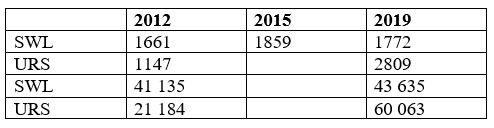
Interestingly thus, URS increased by 5700 procedures per year while SWL did not significantly increase: 370 per year only.
It is not evident or explained why the total number of URS increased in such a dramatic way. Were there any indications of overtreatment? For high-volume urologists the increase in URS did not correspond to a similar decrease in SWL.
It is not mentioned how SWL was carried out. With or without anesthesia? With or without urologists?
It seems likely that URS better fits the surgical mind of urologists and that such a factor might have been of importance.
Because results of ureteral and kidney stones are not reported separately, it is difficult to come to a relevant explanation. Although stone-free rates generally are lower for kidney stones, the outcome of ureteral stones only marginally differs between URS and SWL.
It is mentioned that reimbursement of stone removal does not explain different preferences for the two treatment modalities. It is the reviewer’s suspicion, however, that the dramatically increased use of URS does! The conclusion is that for urologists in general and for young urologists in particular, URS gives a higher degree of immediate procedure satisfaction.
Hans-Göran Tiselius


Comments