

Hsu M. et al., 2026: Trends of surgical interventions for nephrolithiasis over the past decade: a population-based analysis.
Hsu M, Majeed AJ, Kane JA, Clark JY.
Transl Androl Urol. 2026 May 30;15(5):154. doi: 10.21037/tau-2026-1-0137. Epub 2026 May 26.
Abstract
Background: Nephrolithiasis is common and often requires surgical interventions, which include extracorporeal shockwave lithotripsy (SWL), percutaneous nephrolithotomy (PCNL), and ureteroscopy (URS). As our understanding of nephrolithiasis has evolved, along with technological advances in surgical management, the preferred methods of treatment have evolved. This study aims to describe population-based trends in SWL, PCNL, and URS over the past decade.
Methods: Data were collected on patients aged 18-100 years who received SWL, PCNL, or URS between January 2014 and December 2023 using the TriNetX database. Cohorts were classified by year using Current Procedural Terminology and International Classification of Diseases codes. Basic statistics were conducted utilizing R.
Results: A total of 268,628 records were identified. URS procedures accounted for the majority of procedures in 2014 (59.27%), followed by SWL (33.61%) and then PCNL (7.11%). URS procedures rose to encompass 75.77% (+16.50%) of all procedures in 2023, while SWL dropped to 17.06% (-16.55%). PCNL remained consistent at 7.16% (+0.05%). Within URS, the observed sex ratio favored men between 2014 and 2019, but favored females consistently between 2020 and 2023. The sex ratio for SWL skewed towards men each year, while PCNL showed a female predominance.
Conclusions: URS is even more frequently utilized to surgically manage nephrolithiasis. PCNL and SWL accounted for a smaller proportion of procedures in 2023 compared to 2014, with notable decreases in SWL. In 2020, the proportion of females receiving URS exceeded males, aligning with recent literature suggesting rising stone incidence in females.
Comment Hans-Göran Tiselius
The authors studied how stone surgical interventions were applied during a 10-year period (2014-2023) The result was obtained from 268 628 patient records and is similar to what we have seen in other worldwide epidemiological studies. The frequency of stone removing procedures were as follows:
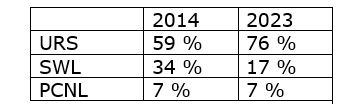
URS dominated already in 2014 but increased further. Most remarkable was the decline in SWL, accounting for only 17 % in 2023. Another interesting observation was that stone formation increased in women and that the gender gap was changed.
In this report as well as in others of this kind there is no explanation why SWL is decreasing so rapidly. Some points might, however, be worthwhile to consider.
- Modern lithotripters are less efficient than previous devices were and there is a narrowing of the indications.
- SWL treatments are not carried out in an optimal way.
- Several years ago, SWL in many places were handed over to nurses and/or technicians. This means that urologists in general have a too weak understanding of SWL. Accordingly, the treatments are carried out in a too stereotypic way.
- There is no or very little modification of the SWL treatment method. From this follows that there is very little directed research.
- It is obvious that the principle for analgesia varies considerably and, in too many reports, it is obvious that pain treatment is insufficient. Undoubtedly, this leads to undertreatment and need of more treatments or auxiliary procedures.
- Many of the urologists who in one way or the other are involved in SWL find the method boring and accordingly, they are more attracted by endourological procedures that also have developed technically in a much more efficient way.
- One reason for the direction in which SWL has developed is the assumed need of pain treatment. There is no doubt that SWL cannot be successful without adequate pain relief. But it also is a misunderstanding that the power of the original HM3-device was impossible to use without general or regional anaesthesia. With modern analgesics such as alfentanil and propofol in small intermittent doses, it is possible to use more powerful SWL than commonly is used today.
It is the reviewer’s opinion that SWL can be used more extensively, but with slight modifications of energy density and shock wave focus geometry. In that way SWL might be improved and remain as a superior non-invasive or least invasive technology ideally combined with fragment elimination procedures.
Hans-Göran Tiselius


Comments