

Nedbal C. et al., 2025: Cost and Effectiveness of Flexible Ureteroscopy Versus Shockwave Lithotripsy for Urolithiasis: A Systematic Review and Meta-analysis by the European Association of Urology Endourology Section.
Nedbal C, Geraghty R, Tramanzoli P, Sessa D, Gauhar V, Galosi AB, Gregori A, Somani BK
Eur Urol Focus. 2025 Nov;11(6):1012-1022. doi: 10.1016/j.euf.2025.06.004 FREE ARTICLE
Abstract
Background and objective: We conducted a systematic review and meta-analysis to compare the cost and effectiveness of flexible ureteroscopy (URS) and shockwave lithotripsy (SWL) in the management of urolithiasis. Given the widespread use of both modalities, comparison of their stone-free rates (SFRs), retreatment rates, complications, costs, and hospital length of stay (LOS) can provide valuable insights for optimizing treatment strategies.
Methods: A systematic review was conducted according to the Preferred Reporting Items for Systematic Reviews and Meta-Analyses guidelines, with searches of the PubMed, Cochrane, and Google Scholar databases for relevant studies. The inclusion criteria were comparative studies analysing costs and clinical outcomes of SWL and URS for urolithiasis management. The meta-analysis included 22 studies involving 146 845 patients, of whom 81 772 (55.7%) underwent SWL and 65 073 (44.3%) underwent URS. Statistical analyses were performed using R. Random-effects or fixed-effect models were applied, depending on study heterogeneity. Subgroup analyses by stone size and location were also conducted.
Key findings and limitations: URS had a significantly higher SFR (82.2% vs 64.4%; p < 0.001) and a significantly lower retreatment rate (10.6% vs 29.4%; p < 0.001) in comparison to SWL. There were no significant differences between URS and SWL in the overall complication rate (22.6% vs 22.5%), the mean procedural cost ($2546.20 ± $1297.30 vs $2830.40 ± $1652.10), or mean LOS (2.8 d for both). Subgroup analyses confirmed similar trends across stone size and location categories.
Conclusions and clinical implications: While direct procedural costs were only slightly lower for URS, this modality had superior efficacy, with higher SFR and lower retreatment rates, suggesting it is a more cost-effective option in the long term. These findings support preference for URS for urolithiasis treatment when considering both clinical and economic outcomes.
Comment Hans-Göran Tiselius
The conclusion from this systematic analysis was that the results of URS were superior to those of SWL. Stone-free rates were 85% and 64%, respectively. As expected, the retreatment rate was lower for URS (10%) compared with that for SWL (29%).
That the stones were in the ureter in most studies is of particular interest and the overall results of SWL are both surprising and disappointing. But details regarding SWL are not given in the report. So, what is the problem and how can SWL of ureteral stones be improved with modern lithotripters?
Own data for SWL of ureteral stones were as follows [1]:
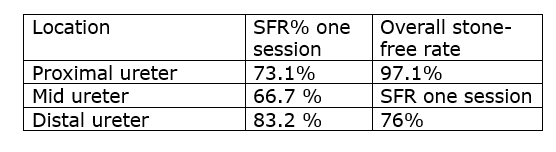
Mean number of sessions: 1.31
It is indeed surprising that the results of SWL for ureteral stones are not better. Why is this so?
It is my understanding that too many patients are given SWL with too low energy. The advantage of SWL is that it is a non-invasive or least invasive treatment, not that it should be possible to carry out the treatment with minimal or no analgesics. Many patients are treated with only an i.m. injection of diclofenac. This is in my opinion an insufficient routine. We also administered diclofenac to our patients, but only as a premedication suppository. Effective pain treatment also required small intermittent doses of alfentanil and propofol. This medication, however, cannot be given by technicians, but by nurses and doctors following adequate education.
That spinal or general anesthesia was necessary for treatment with the Dornier HM3 device was a misunderstanding. I personally used that equipment with analgesics and sedatives between 1987 and 1998. This possibility was never sufficiently noted. Instead, various modifications of the lithotripters were made.
One important modification assumed that the entrance angle of the shock wave should be increased to accomplish pain reduction. This led to development of lithotripters with high pressure small focal volumes. This was a change that also caused an increased rate of perinephric hematomas.
In most reports there is no information on how SWL was completed for proximal, mid and distal ureteral stones. It is also important to avoid various obstacles in the shock wave path.
A lot can be said about how SWL currently is carried out, but the bottom-line is that too many centers use shockwaves with insufficient power.
Reference
Tiselius HG. How efficient is extracorporeal shock wave lithotripsy with modern lithotripters for removal of ureteral stones? J Endourol 2008; 22: 249-253
Hans-Göran Tiselius


Comments