

Siranart N. et al., 2025: Per-oral Pancreatoscopy-Guided Lithotripsy Versus Extracorporeal Shock Wave Lithotripsy in Pancreatic Stone: A Meta-Analysis.
Noppachai Siranart, Landon Kozai, Daniel Martin Simadibrata, Nawan Pornananrat, Peerada Roongphornchai, Patavee Pajareya, Rinrada Worapongpaiboon, Somkiat Phutinart, Wichapol Dendumrongsup, Yanisa Chumpangern, Aunchalee Jaroenlapnopparat, Kornpong Vantanasiri, Kittithat Tantitanawat
Dig Dis Sci. 2025 Apr 2. doi: 10.1007/s10620-025-08952-w
Abstract
Introduction: Pancreatic duct stones (PDS) pose a significant clinical challenge, and choosing treatment modality is crucial to achieving optimal outcomes. Extracorporeal shock wave lithotripsy (ESWL) has long been regarded as the primary intervention for PDS. However, per-oral pancreatoscopy-guided lithotripsy (POP), both electrohydraulic lithotripsy (EHL-POP) and laser lithotripsy (LL-POP), has emerged as a promising endoscopic alternative. This meta-analysis compares the efficacy and safety profiles of EHL-POP, LL-POP, and ESWL for treating PDS.
Methods: A search of MEDLINE, EMBASE, and Cochrane databases until November 2023 was conducted to identify studies assessing the use of EHL-POP, LL-POP, or ESWL for the treatment of PDS. Primary outcomes were technical success and clinical success of stones. Secondary outcomes were any adverse events (AEs) and the incidence of post-intervention pancreatitis.
Results: A total of 45 observational studies were included. Among the 9624 patients with PDS analyzed, 373 underwent POP (238 EHL-POP and 135 LL-POP), while 9,251 underwent ESWL. The pooled technical and clinical success rates of ESWL versus POP were 85.5% (95% CI: 79.1-90.2%) vs. 88.1% (95% CI: 75.1-94.8%) (p = 0.66) and 78.5% (95% CI: 70.9-84.5%) vs. 81.6% (95% CI: 65.1-91.4%) (p = 0.69), respectively. The pooled technical success rate of EHL-POP was 85.2% (95% CI: 68.5-93.9%, I2 = 63%), which was comparable to LL-POP at 92.7% (95% CI: 64.4-98.9%, I2 = 0%) (p = 0.48). The clinical success rates of EHL-POP and LL-POP were 74.4% (95% CI: 50.7-89.2%, I2 = 48%) and 85.7% (95% CI: 63.9-95.3%, I2 = 68%), respectively (p = 0.38). The rates of any adverse events and post-intervention pancreatitis for ESWL vs. POP were 10.1% (95% CI: 5.5-17.6%, I2 = 95%) vs. 9.3% (95% CI: 4.1-19.6%, I2 = 55%) (p = 0.87) and 4.3% (95% CI: 3.1-5.9%, I2 = 85%) vs. 2.8% (95% CI: 1.3-6.1%, I2 = 0%) (p = 0.32), respectively.
Conclusion: Both EHL-POP and LL-POP, emerges as highly effective and safe alternatives for managing PDS, with safety profiles comparable to ESWL. POP could be considered as an alternative first-line option to ESWL for PDS.
Comment Hans-Göran Tiselius
Whereas the current role of SWL for removal of urinary tract stones is under debate, it is noteworthy that it is the preferred alternative for treatment of pancreatic duct stones > 5 mm. Follow-up with ERCP clearance has proven successful. Recently introduced alternatives with electrohydraulic lithotripsy (EHL) and laser lithotripsy (LL) are competitive methods carried out via peroral pancreatoscopy.
This study carried out by gastroenterologists in Thailand and USA aimed to compare the latter two methods with SWL. The report is a systematic review and meta-analysis of results in available databases. The outcome variables were technical success, clinical success and adverse events. For the specially interested reader the authors have listed details in tables and figures. For convenience I have summarized the essential information in the table below.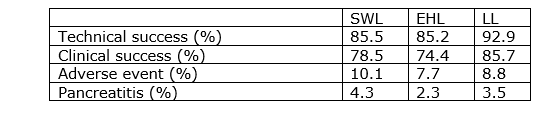
The conclusion was that there were no major differences between the treatment modalities. When considering the minor advantages with LL it might be noted that SWL is the only non-invasive approach.
Hans-Göran Tiselius


Comments