
EMTT vs. PEMF: What is the difference?

Technical and clinical differences in musculoskeletal disorders
Pulsed electromagnetic field therapy (PEMF) and Extracorporeal Magnetotransduction Therapy (EMTT) are often grouped together under the general term »magnetic therapies«. Both therapy approaches are used in clinical areas such as orthopaedics, sports medicine, physiotherapy and pain management, particularly in the context of musculoskeletal disorders. However, their underlying physical properties and biological interactions differ considerably. What distinguishes EMTT from PEMF? The following overview highlights similarities and key differences.
Why EMTT and PEMF are often considered similar
In everyday clinical practice, EMTT and PEMF are sometimes perceived as comparable technologies. This is because both belong to the broader category of magnetic field-based therapies and use pulsed electromagnetic fields as their underlying treatment modality. In addition, they share several practical characteristics:
- are non-invasive outpatient procedures
- are typically performed with the patient fully clothed
- are used in treatment concepts addressing chronic pain and tissue regeneration
These similarities in application can create the impression that both technologies produce comparable biological effects. However, a closer look at their physical parameters reveals important differences in how electromagnetic energy is generated and delivered to biological tissue.
Key differences between EMTT and PEMF
Despite certain similarities in application, EMTT and PEMF differ in several important technical and physiological aspects.
Frequency and rise time
EMTT uses high oscillation frequencies in the range of approximately 100–300 kHz combined with rapid rise times in the microsecond range. This means that within a single EMTT pulse, multiple rapid magnetic oscillations occur. PEMF systems, in contrast, typically generate a single, slower magnetic pulse with much lower frequencies and more gradual field changes.
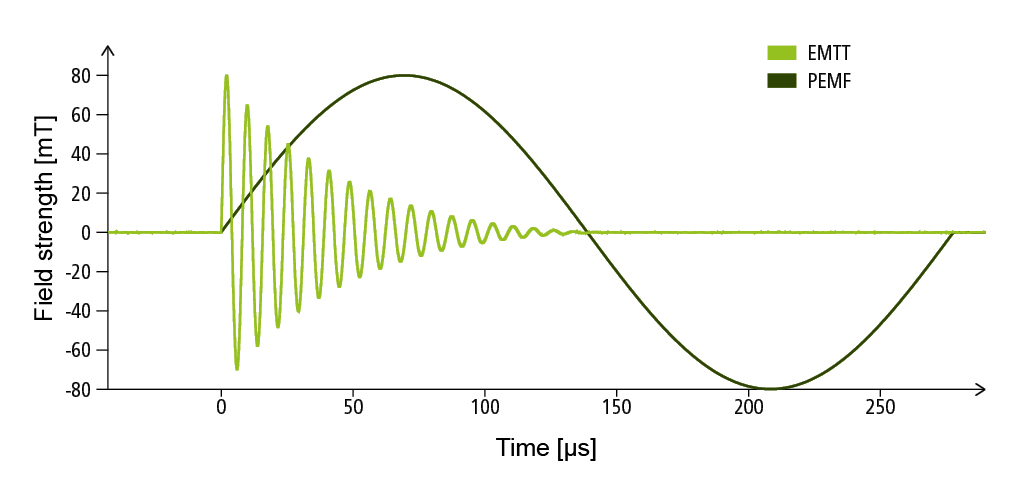
Comparison of a single EMTT and PEMF pulse
Effective transduction power and penetration depth
With an effective transduction power exceeding 60 kT/s, EMTT is characterised by a high level of energy transfer. Quantitative measurements have demonstrated electromagnetic stimulation at tissue depths of up to approximately 18 cm. This distinguishes EMTT from conventional magnetic field therapies, which generally operate with different technical characteristics.
Neuromuscular response during treatment
EMTT operates at substantially higher oscillation frequencies than many PEMF systems and is not intended to produce direct neuromuscular stimulation. While magnetic fields can induce nerve depolarisation under appropriate stimulation conditions, visible muscle contractions are generally not observed during EMTT treatment, suggesting that the applied signal characteristics predominantly interact with tissues through non-neuromuscular mechanisms.
Patient comfort during application
Since EMTT typically does not provoke neuromuscular activation, treatments generally do not produce involuntary muscle twitching. The perceived sensation during application is therefore usually mild and well tolerated, while the high-energy electromagnetic pulses still provide efficient stimulation of the target tissue.
Clinical applications of EMTT
Current clinical research on EMTT primarily focuses on chronic musculoskeletal disorders. Investigated indications include:
- Degenerative joint diseases: Wear and tear conditions such as arthrosis (knees, hips, hands, shoulders, elbows), herniated discs, spondylarthrosis
- Pain treatment: (Chronic) pain, for example, back pain, lower back pain, tension, radiculopathy
- Sports injuries: (Chronic) inflammation of tendons and joints, tendon overuse syndromes, osteitis pubis
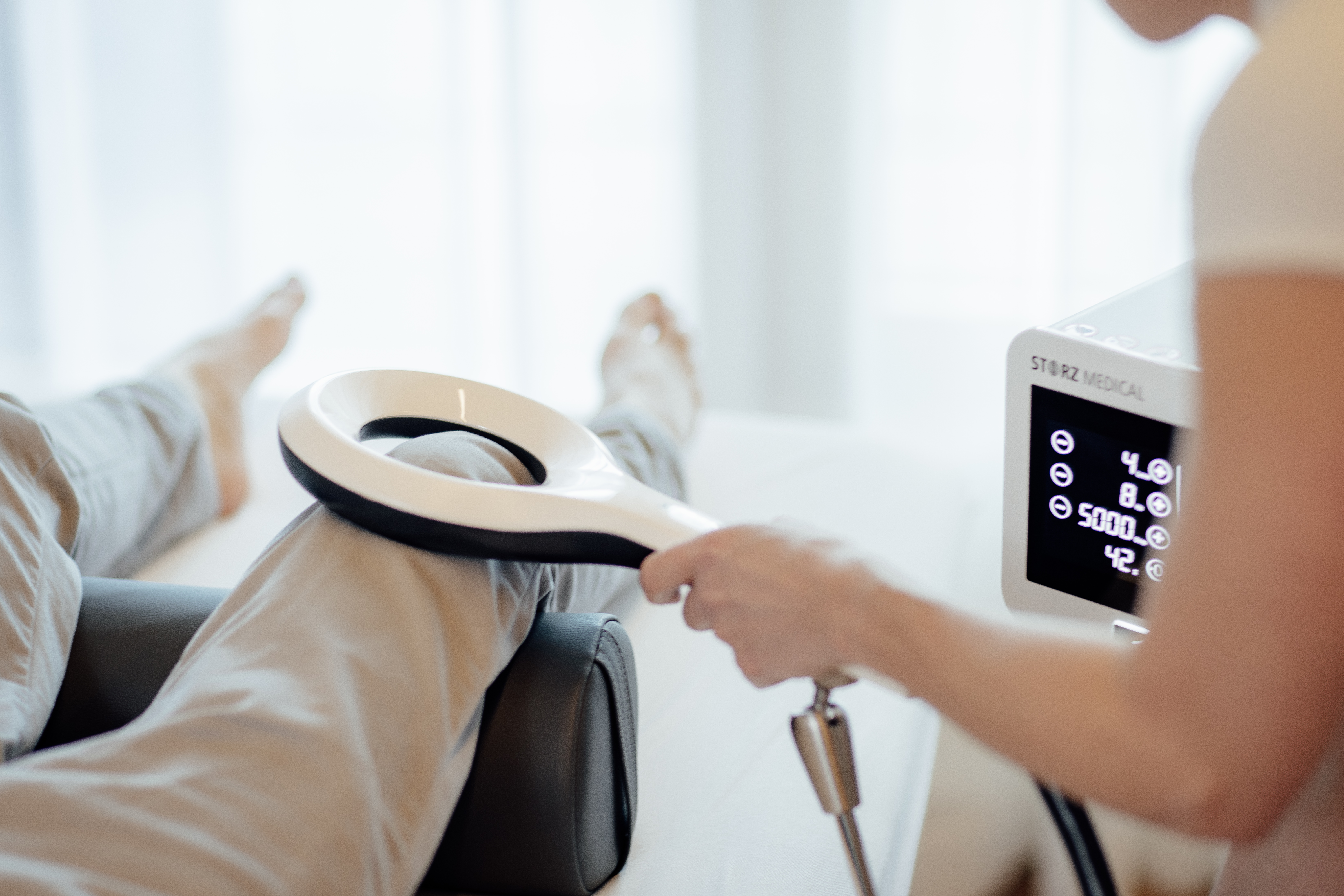
Several prospective and randomised studies have reported clinically relevant reductions in pain and improvements in functional outcomes in conditions such as shoulder enthesiopathies, chronic mid-portion Achilles tendinopathy and osteitis pubis.1,2,3
In patients with chronic low back pain, EMTT has also been evaluated as an adjunct to conventional therapy, with improvements in pain scores and disability indices reported during follow-up.4
In addition, EMTT has been investigated in combination with Extracorporeal Shock Wave Therapy (ESWT). Studies suggest that combining mechanical stimulation with electromagnetic stimulation may further enhance therapeutic outcomes in certain musculoskeletal conditions.5-9
First case reports and feasibility studies have also described the integration of EMTT into treatment strategies for complex bone-healing scenarios, including non-union fractures and postoperative bone stimulation.6,8,9
Evidence landscape: EMTT and PEMF
Direct head-to-head clinical studies comparing EMTT and PEMF are currently not available. As a result, the differences between the two technologies are primarily discussed based on their physical characteristics and the available clinical evidence for each modality.
Experimental research suggests that EMTT may influence biological processes relevant to tissue regeneration. In vitro studies have demonstrated effects on tenocyte behaviour, extracellular matrix remodelling and osteoblast differentiation during bone formation.10,11
In clinical settings, EMTT has been investigated in several prospective and randomised studies focusing on chronic musculoskeletal disorders, including degenerative joint disease, shoulder enthesiopathies, chronic Achilles tendinopathy, osteitis pubis and non-specific low back pain.1-5
Additional case reports and pilot data suggest beneficial effects when EMTT is combined with ESWT in complex bone-healing scenarios, including non-unions of small bones and postoperative fracture management, as well as in off-label applications such as post-radiotherapy pain in gynaecological cancer.12,6-9
Across these investigations, EMTT has generally been well tolerated, with reported adverse events predominantly mild and transient.3,5-9,11,12
Key considerations for clinical practice
For orthopaedic, sports medicine and pain specialists, several points may be relevant when considering electromagnetic treatment approaches in musculoskeletal disorders:
- EMTT and PEMF should not be used synonymously. EMTT fulfils specific high-energy, high-frequency criteria that distinguish it from many conventional PEMF systems.
- In selected musculoskeletal disorders such as degenerative joint disease, tendinopathies and chronic back pain, EMTT has demonstrated clinically relevant improvements in pain and functional outcomes in prospective and randomised studies.
- EMTT may be particularly relevant when targeting deeper anatomical structures, such as the hip, spine or entheses, or when combining mechanical stimulation (ESWT) with bioelectrical stimulation concepts.
- Differences in physical parameters, such as magnetic field strength, oscillation frequency and effective transduction power, should be considered when evaluating electromagnetic treatment technologies.
References
- Gerdesmeyer, L., et al. (2023). Prospective double blinded placebo controlled trial of high energetic magneto transduction therapy in shoulder joint enthesiopathies. Sports Orthopaedics and Traumatology, 39(2), 212. https://doi.org/10.1016/j.orthtr.2023.03.045
- Klüter, T., et al. (2018). Electromagnetic Transduction Therapy in Patients with Chronic Aseptic Osteitis Pubis. Journal of Orthopedic Research and Therapy, 3(12), 1113.10.29011/2575-8241.001113
- Gerdesmeyer, L., et al. (2017). Electromagnetic Transduction Therapy for Achilles Tendinopathy: A Preliminary Report on a New Technology. The Journal of Foot and Ankle Surgery, 56(5), 964-967. https://doi.org/10.1053/j.jfas.2017.06.014
- Krath, A., et al. (2017). Electromagnetic transduction therapy in non-specific low back pain: A prospective randomised controlled trial. Journal of Orthopaedics, 14(3), 410-415. https://doi.org/10.1016/j.jor.2017.06.016
- Klüter, T., et al. (2018). Electromagnetic transduction therapy and shockwave therapy in 86 patients with rotator cuff tendinopathy: A prospective randomized controlled trial. Electromagnetic Biology and Medicine, 37(4), 175-183. https://doi.org/10.1080/15368378.2018.1499030
- Knobloch, K., et al. (2025). Conservative Treatment of Nonunion of the Hamulus Ossis Hamati Using Focused Electromagnetic Extracorporeal Shock Wave Therapy (ESWT) and Extracorporeal Magnetotransduction Therapy (EMTT): A Case Report. Journal of Orthopaedics and Sports Medicine, 7(3), 392-396. https://doi.org/10.26502/josm.511500219
- Knobloch, K., (2022). Novel Extracorporeal Magnetotransduction Therapy with Magnetolith and Focused Electromagnetic Extracorporeal Shockwave Therapy in Medial Meniscal Tear – A Case Report. Journal of Regenerative Science, 2(1), 32-25. 10.13107/jrs.2022.v02.i01.43
- Knobloch, K., (2021). Extracorporeal magnetotransduction therapy (EMTT) and high-energetic focused extracorporeal shockwave therapy (ESWT) as bone stimulation therapy for metacarpal non-union – a case report. Handchirurgie Mikrochirurgie Plastische Chirurgie, 53(1), 82-86. https://doi.org/10.1055/a-1344-8126
- Knobloch, K,. (2021). Novel extracorporeal magnetotransduction therapy with Magnetolith and high energy focused electromagnetic extracorporeal shockwave therapy as bone stimulation therapy for scaphoid nonunion A case report. Medicine: Case Reports and Study Protocols, 2(1), e0028. https://doi.org/10.1097/MD9.0000000000000028
- Mancini, M., et al. (2025). Electromagnetic Transduction Therapy (EMTT) Enhances Tenocyte Regenerative Potential: Evidence for Senolytic-like Effects and Matrix Remodeling. International Journal of Molecular Sciences, 26(15), 7122. https://doi.org/10.3390/ijms26157122
- Gerdesmeyer, L., et al. (2024). Extracorporeal Magnetotransduction Therapy as a New Form of Electromagnetic Wave Therapy: From Gene Upregulation to Accelerated Matrix Mineralization in Bone Healing. Biomedicines, 12(10), 2269. https://doi.org/10.3390/biomedicines12102269
- Anchuelo, J., et al. (2025). 3045 Preliminary Results of Magnetolith Therapy for Pain Management in Gynecological Cancer Patients Post-Radiotherapy. Radiotherapy and Oncology, 206(1), 1541-1542. https://doi.org/10.1016/S0167-8140(25)01455-0


